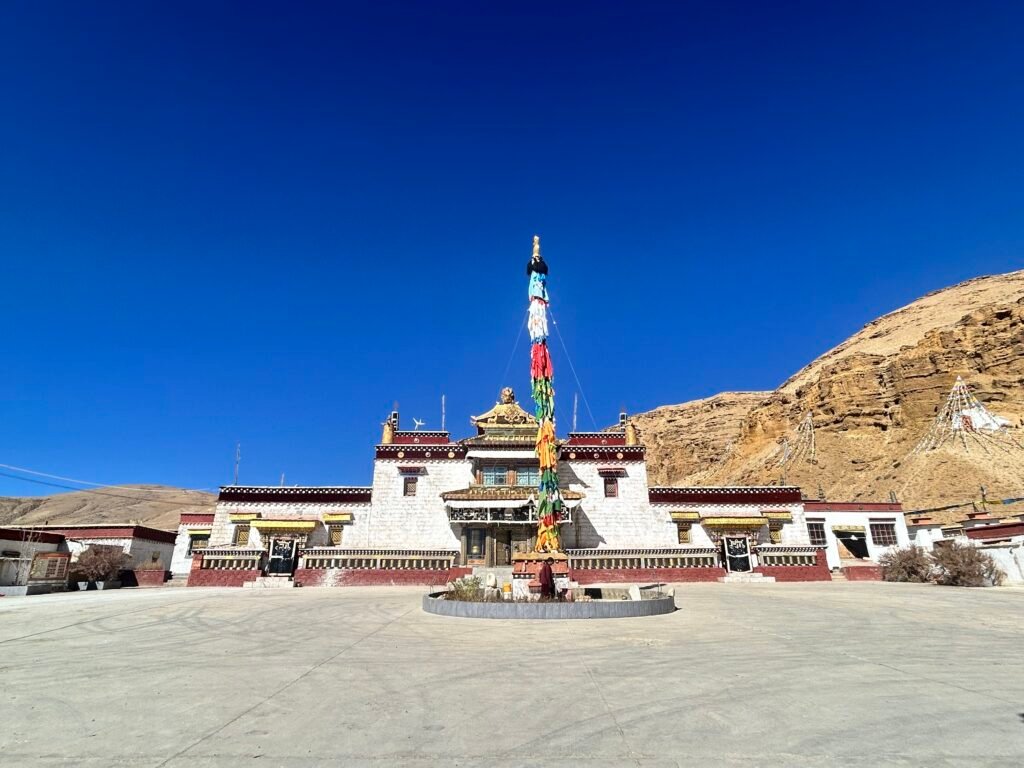
Gurugyal Monastery (དགུ་རུ་རྒྱལ་དགོན་) is one of the most spiritually significant Bon sites in western Tibet. Nestled at the foot of the majestic Jongchen Bumpa Mountains in Menshi ( མོན་འཚེར) Township, southeast of Ngari’s county seat, the monastery stands amid some of the most important ruins of the ancient Zhang Zhung Kingdom. This sacred landscape includes the Upper Gate of Zhang Zhung and the legendary Qionglong Silver City, marking the area as the birthplace of Bon religion and the homeland of its founder, Shenrab Miwoche.
Surrounded by vast highland scenery and deep historical echoes, Gurugyal Monastery offers rare insight into Tibet’s indigenous spiritual tradition, far from the more familiar Buddhist centers.
Foundation and Spiritual Lineage
Gurugyal Monastery was founded in 1936 by the revered Bon master Khyungdrak Jigme Namkha Dorje (琼追・晋美南卡多杰), making it the only Bon monastery in the Ngari region. Despite its relatively recent establishment, the monastery carries an ancient spiritual lineage rooted in the Zhang Zhung civilization.
The monastery complex consists of several sacred halls, each with unique architectural and ritual importance:
- Kadong Lhakhang, the main assembly hall
- Tsuklakhang, supported by 24 pillars
- Tsamkhang, distinguished by its five pillars
- Gaden Julakhang, featuring six pillars and housing important Bon statues
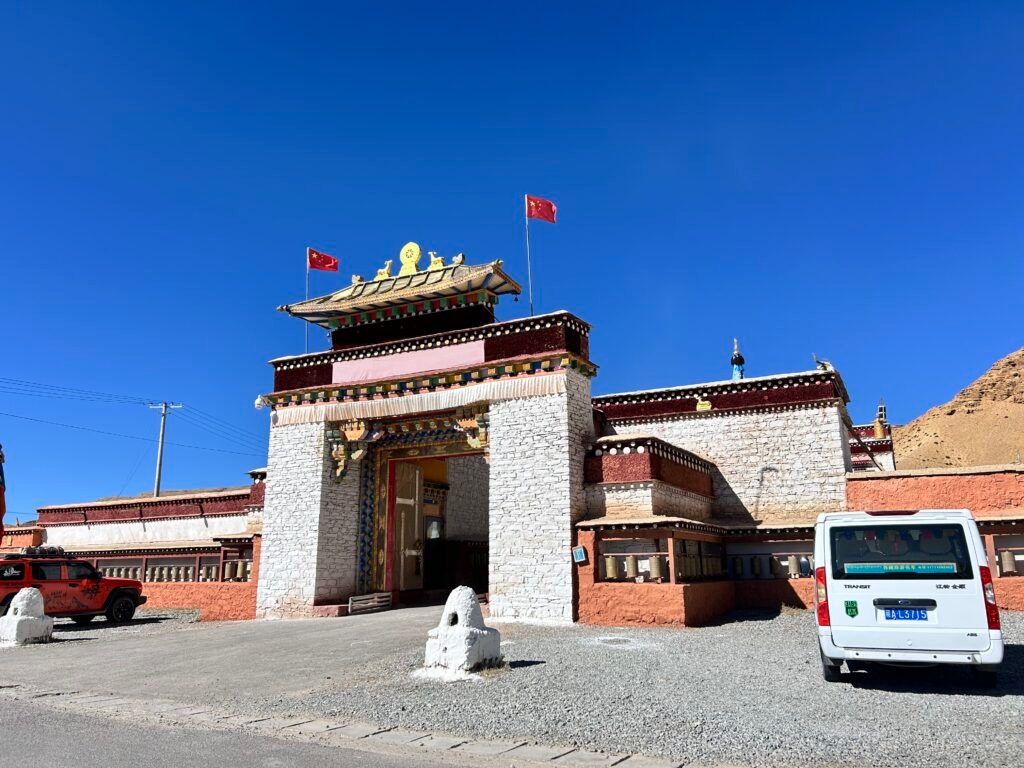
Inside these halls are precious images of Bon deities, ritual instruments, and sacred relics central to Bon practice. Unlike Tibetan Buddhist monasteries, circumambulation here is done counterclockwise, following Bon tradition.
Unique Bon Architectural Features
Guru Gyal Monastery displays several elements unique to Yungdrung Bon, including:
- White as the dominant color
- Golden Garuda (Great Bird) roof decorations
- Counterclockwise circumambulation paths
These features clearly distinguish it from nearby Tibetan Buddhist monasteries.
Sacred Art, Scriptures, and Revival
Gurugyal Monastery preserves 12 rare Thangka paintings illustrating the virtuous deeds of Shenrab Miwoche, along with an extensive collection of Bon scriptures, stupas, and ritual objects. These treasures reflect the depth and continuity of Bon religious philosophy.
The monastery was severely damaged during the Cultural Revolution but was carefully rebuilt in 1983. Today, it is home to around ten resident monks and is led by Gelong Tenzin Wangdrak, a respected Tibetan medical expert and one of the founding figures of Tibetan medicine in the Ngari region. Under his guidance, Gurugyal Monastery serves both as a religious center and a guardian of traditional knowledge.
The monastery now preserves more than 20,000 volumes of Bon scriptures, including rare handwritten editions of the Bon Kangyur and Bon Tengyur, making it a vital center for Bon textual preservation and research.
Yungdrung Rinchen Cave (雍仲仁钦洞): Ancient Meditation Site
Near the monastery lies Yungdrung Rinchen Cave, regarded as the oldest meditation cave in Tibet, with a history of nearly 3,000 years. This sacred cave was once used by the great master Zhanba Nanka and later by Khyungdrak Jigme Namkha Dorje himself.
The cave remains a powerful spiritual site, attracting pilgrims and practitioners who seek solitude, reflection, and a deeper connection to the origins of Bon tradition.
Understanding Bon Religion (Bon-po)
Bon religion originated around the 5th century BCE in the ancient Zhang Zhung civilization, long before the arrival of Buddhism in Tibet. As Tibet’s indigenous belief system, Bon emphasizes harmony between humans and nature, revering mountains, rivers, spirits, and elemental forces.
Bon rituals focus on purification, healing, longevity, and spiritual liberation. Over time, Bon evolved into a structured religious system with monasteries, scriptures, and philosophical teachings. Despite historical challenges, Bon continues to thrive today, with active monastic communities and followers across Tibet and the Himalayan region.
Shenrab Miwoche: Founder of Bon Tradition
Shenrab Miwoche (gshen-rab-mi-po-che) is revered as the enlightened founder of Bon. Born into royalty in ancient Zhang Zhung, he renounced worldly power to teach a spiritual path grounded in compassion, wisdom, and ethical conduct.
He established Yungdrung Bon, a reformed tradition that rejected animal sacrifice and promoted moral discipline. Shenrab Miwoche is also credited with advancing early Tibetan knowledge in medicine, crafts, astrology, and ritual sciences, and for organizing Bon into branches such as Phya-gshen and Srid-gshen. His teachings continue to shape Bon philosophy and practice today.
Visiting Gurugyal Monastery
Gurugyal Monastery is not only a place of worship but also a living symbol of the endurance of Bon culture in Tibet. Its remote location, sacred surroundings, and deep historical roots make it an essential destination for travelers interested in Tibetan spirituality beyond mainstream Buddhist routes.
Religious Activities and Ritual Life
Despite its remote location, Guru Gyal Monastery remains spiritually active throughout the year.
Major Bon Festivals
- Bon Losar (Bon New Year): Celebrated in the first Bon month, featuring rituals, prayers, and traditional dances
- Zhanban Nanka Commemoration Day: Honors the life of the great Bon master
- Yungdrung Bon Dharma Assembly: A summer gathering focused on chanting, rituals, and teachings
Daily Religious Practices
- Morning and evening scripture chanting in the main hall
- Regular meditation in Yungdrung Rinchen Cave
- Counterclockwise circumambulation by monks and pilgrims
Pilgrimage Season
From May to October, pilgrims arrive from Ngari, Nagqu, Lhasa, and other Tibetan regions, making this period especially lively.
Travel Tips for Gurugyal Monastery
- Admission: Free (donations are welcome)
- Opening Hours: 9:30 AM – 5:00 PM
- Location: About 260 kilometers from Ngari’s county seat
- Getting There: Accessible by car or taxi from Shiquanhe, with scenic drives across the Ngari Plateau
The journey to Gurugyal Monastery passes through vast landscapes shaped by wind, sky, and time, offering travelers both visual beauty and spiritual depth. Whether drawn by the ancient legacy of Bon religion, the sacred history of Zhang Zhung, or the quiet power of Tibet’s highland monasteries, Gurugyal Monastery reveals a profound and lesser-known dimension of Tibetan civilization.
Transportation Guide to Guru Gyal Monastery
From Menshi Township
- Distance: 12 km
- Driving Time: About 20 minutes
- Route: Turn left at the “古如江寺” sign from G219 National Highway
From Shiquanhe (Gar County Seat)
- Distance: 180 km
- Driving Time: 4–5 hours
- Route: Via G219 National Highway, with mountainous and gravel sections
Gurugyam Cemetery: Royal Tombs of the Ancient Zhangzhung Kingdom in Ngari
Gurugyam Cemetery, also known as the Guru Gyal Ancient Tombs Site, is one of the most important archaeological discoveries in western Tibet. Located in Ngari (Ali) region, this burial ground represents the largest, deepest, and most concentrated group of Zhangzhung-period elite tombs ever found on the Tibetan Plateau.
Closely connected to the nearby ruins of Qionglong Silver City (Kar Dong)—believed to be the legendary capital of the ancient Zhangzhung Kingdom—the cemetery provides rare physical evidence of early Tibetan civilization before the rise of the Tibetan Empire.