
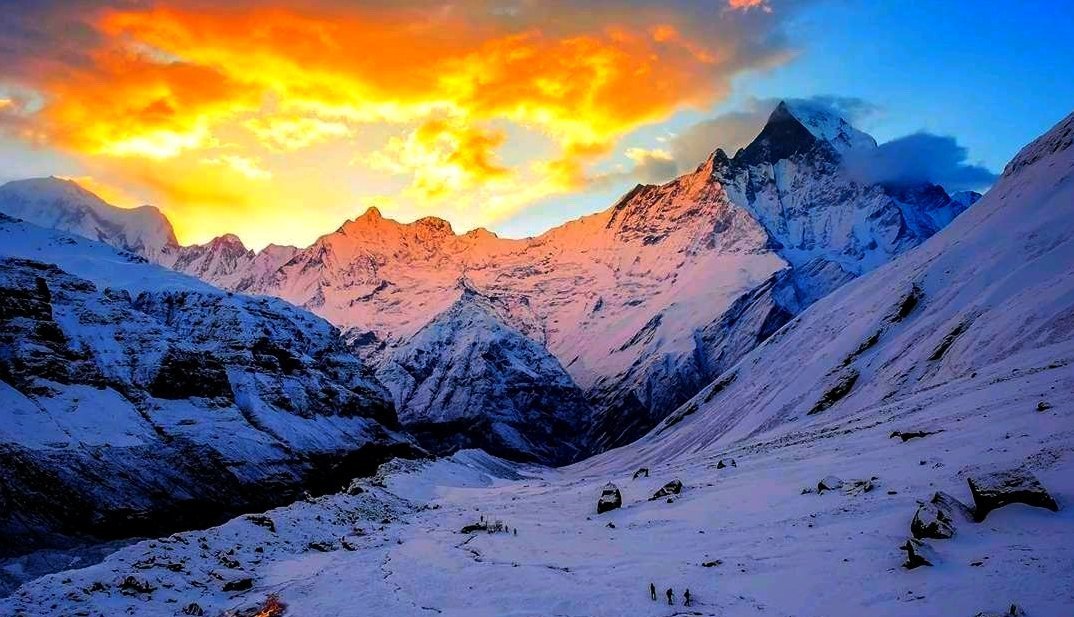
At 8,586 meters, Kanchenjunga is the world’s third-highest peak and the third-highest mountain in the mighty Himalayas. It is a stunning massif composed of five distinct peaks, standing as a majestic symbol on the border of India and Nepal, deeply woven into the fabric of Himalayan spirituality.
This mountain is located in the central part of the Himalayan range, on the border between Nepal and India. It is also said that this snowy mountain has an alternative spelling or name:
Names and Etymology
The mountain Kangchenjunga (རི་བོ་གངས་ཅན་བཅོ་ལྔ) has an elevation of 8,586 meters. The world’s third-highest peak, derives its name from Tibetan origins: Gangchen Dzonga (གངས་ཅན་མཛོད་ལྔ་), which means “The Five Treasures of the Great Snows.” It refers to its five prominent summits symbolizing treasures like salt, minerals, grain, scriptures, and invincible armor. In local Sikkimese Lepcha language, it is Kong-lo-chu, meaning “Snowy Horn,” evoking its horn-like peaks revered as a deity. The Limboo people of eastern Nepal call it Seyok Kangchamjang, or “White and Pure Snow Mountain.” Nepali speakers use Kanchenjunga, a phonetic adaptation. These names underscore its sacred status across ethnic groups.
Influence from of Local Culture and Buddhsim
Kanchenjunga holds deep cultural and spiritual ties to Tibet through shared Buddhist traditions and historical migrations. Sikkim, on the Indian side, was once a Tibetan-influenced kingdom, with Lepcha and Bhutia (Tibetan-descended) communities viewing the mountain as a divine protector linked to Tibetan cosmology. It is associated with Padmasambhava (Guru Rinpoche), the 8th-century Tibetan saint who “tamed” Himalayan demons and designated sacred sites, including Kanchenjunga’s flanks as a “hidden valley” (beyul) for spiritual refuge.
Tibetan folklore portrays it as an abode of mountain gods (lha), with rituals involving offerings to appease deities. Proximity to the Tibetan plateau (via trade routes) fostered exchanges, though modern borders limit access; China’s control over Tibet adds layers to its symbolic role in exile narratives.
Mythical Stories and Folklore
Kanchenjunga is steeped in legends portraying it as a living entity guarded by supernatural forces, blending Tibetan Buddhism, Lepcha animism, and Nepali shamanism. Central is the myth of the “Five Treasures,” where the peaks house divine gifts from the gods—salt for life, minerals for wealth, grain for sustenance, scriptures for wisdom, and weapons for protection—bestowed upon humanity but sealed to prevent misuse, with demons as sentinels. Lepcha lore depicts it as Kong-lo-chu, a horned god demanding annual worship in the third lunar month to avert calamities. Demons (lu) are said to inhabit its caves, punishing intruders; one tale recounts a climber devoured for desecrating a shrine.
Yeti (migoi) sightings, like a 1925 British expedition report, fuel “abominable snowman” myths, symbolizing the mountain’s untamed wildness. Goechala Pass folklore warns of illusory landscapes luring trekkers to doom, while Sikkimese tales link it to blood pheasants as reincarnated warriors. Climbers traditionally halt below the summit to honor these spirits, as in the 1955 ascent. These stories reinforce taboos against full conquest, viewing the peak as a threshold to the divine.
Geographic Identity and Significance
Kanchenjunga rises to 8,586 meters, confirmed by surveys, forming a massive east-west ridge with five treasury peaks: Main (8,586 m, central), Yalung Kang (8,505 m, south), Kangchenjunga South (8,476 m), Kangchenjunga West (8,412 m), and Dropped Peak (8,677 m, north). Straddling the Nepal-India border—Nepal’s Taplejung District (Koshi Province) south and Sikkim’s Mangan District north—it anchors the Greater Himalayan Range in the eastern Himalayas.
Its pyramid shape, with 3,000-meter sheer faces, contrasts glacial valleys like Yalung and Talung, feeding the Arun and Teesta Rivers. Formed by the India-Asia collision (45 million years ago), it uplifts 5-10 mm annually via thrust faults, with active seismicity (Zone IV). The massif spans 2,035 km² in Nepal’s Kanchenjunga Conservation Area and India’s Khangchendzonga National Park, featuring alpine meadows, rhododendron forests, and icefalls prone to avalanches.
A Sacred Border Peak
| Aspect | Indian Side (East) | Nepali Side (West) |
| Geographical Belonging | Sikkim State, India (The only $8000\text{m}+$ peak entirely within India’s current territory) | Eastern Nepal |
| Historical Status | Historically the highest peak of the former Kingdom of Sikkim, now India’s Sikkim State. | |
| Cultural Significance | The traditional Sacred Mountain of the Sikkimese people, revered as the “Abode of Gods.” | Core mountain within the Tibetan Buddhist cultural sphere, shared by Nepali and Tibetan communities. |
The Name: “Five Treasures of the Snow”
The mountain’s name, Kanchenjunga, derives from the Tibetan Kangchenjunga (ཁམས་ཅན་ལྕམ་གུ་), which literally means “Five Treasures of the Snow.”
- Meaning: These “Five Treasures” symbolically align with key elements of Tibetan Buddhism, typically referring to five divine objects: the Buddha, the Dharma, the Sangha, the Precious Umbrella, and the Conch Shell.
- Physical Echo: The name physically reflects the massif’s composition of five distinct peaks, reinforcing the peak’s divine nature.
Minerals and Resources
The Kanchenjunga region, part of Sikkim’s metamorphic belt, hosts diverse minerals from Himalayan orogeny. Key deposits include high-grade marble (dolomite-rich) in Tsungthang, Tsongo, and Tolong areas, quarried for export; copper, lead, and zinc ores in Mangan and Dikchu valleys; and graphite, coal, and limestone in lower foothills. Garnets, abundant in gneissic rocks, record tectonic history via chemical zoning, aiding geological studies. Lesser resources: slate, quartzite, and minor gold placers in rivers. Sikkim’s mining is regulated for sustainability, focusing on non-metallics to preserve biodiversity; the 2025 state policy emphasizes eco-friendly extraction, with marble production at ~50,000 tons annually supporting local economy without large-scale operations near the peak.
Flora and Fauna
As a UNESCO Biosphere Reserve (since 2000), Kanchenjunga boasts exceptional biodiversity across altitudinal zones: subtropical (below 1,000 m) with sal forests; temperate (1,000-3,000 m) rhododendrons (36 species, including rare R. edgeworthii); subalpine (3,000-4,000 m) firs, oaks, and orchids (over 600 species, like lady’s slipper); and alpine (above 4,000 m) mosses, lichens, and cushion plants. Popular flora: Blue poppy (Meconopsis), Himalayan lily, and medicinal herbs like yarsagumba (cordyceps).
Fauna thrives in this hotspot: Snow leopards (Panthera uncia) and red pandas (Ailurus fulgens) in high forests; Himalayan black bears, musk deer, and blue sheep (Pseudois nayaur) on slopes; blood pheasants (Ithaginis cruentus) and satyr tragopans in undergrowth. Avifauna includes over 500 birds, like impeyan pheasants. Conservation via anti-poaching patrols protects endangered species, with 2025 surveys noting population stability amid warming.
Importance (Historical, Scientific, and Cultural)
Kanchenjunga embodies spiritual sanctity and human ambition: First surveyed as Peak IV in 1849, its unclimbed status until 1955 (British team of Joe Brown and George Band via Southwest Face, halting 5 meters short for respect) marked a milestone, with only ~400 summits by 2025 due to difficulty (fatality rate ~22%). Culturally, it’s Sikkim’s guardian deity, integral to Bhutia festivals like Pang Lhabsol, honoring it as a protector. Scientifically, it drives biodiversity research (e.g., 2024 garnet studies on tectonics) and high-altitude ecology. Economically, it sustains ~20,000 livelihoods via tourism, contributing 15% to Sikkim’s GDP.
| Aspect | Key Facts |
|---|---|
| Historical Milestones | 1955: First ascent (British, respectful stop); 1973: First solo (Polish); 1998: First Indian woman (Bacendri Pal); 2025: 70th anniversary events with virtual summits. |
| Scientific Contributions | Biodiversity hotspot (3,000+ plant species); GLOF monitoring; tectonic models from minerals. |
| Cultural/Economic Impact | Sacred no-summit tradition; $5-7 million annual tourism revenue; funds conservation in parks. |
Geopolitical Aspects
Kanchenjunga’s border position amplifies its role in India-Nepal relations, with the 1950 treaty affirming the line at the Main Summit, but minor disputes over trijunctions with China (Tibet) persist amid 1960s Sino-Indian War echoes. Sikkim’s 1975 accession to India, opposed by Nepal initially, stabilized access but sparked Bhutanese border sensitivities. No active conflicts, yet it’s a strategic water source (Teesta River for hydropower). China’s Tibetan developments raise concerns over upstream dams, though India-Nepal joint patrols maintain peace. Tourism treaties facilitate cross-border treks, symbolizing cooperation.
Global Climate Effects
Kanchenjunga’s glaciers, part of the “Third Pole,” are melting at 0.5-1 m/year, accelerated by +1.5°C warming and black carbon (“Black Kanchenjunga”) from pollution, reducing ice cover 15% since 2000. 2024 floods/landslides (June-October) displaced 5,000, linked to Yalung Glacier retreat; a new proglacial lake at its terminus grew 20% in 2024, posing GLOF risks to 100,000 downstream. Himalayan-wide, this threatens water for 1.9 billion, with peak runoff by 2040 followed by scarcity. 2025 UN reports warn of cascading impacts: biodiversity loss (20% species at risk), agriculture disruption in Indo-Gangetic plains. Mitigation includes Nepal’s 2025 early-warning systems.
Tourism and Other Impacts
Kanchenjunga attracts ~3,000 trekkers annually for its remote 21-day circuit (north/south bases, Goechala Pass), emphasizing low-impact over summiting. 2025 permits: Restricted Area Permit (RAP, $10/person/week, max 150 days) and Kanchenjunga Conservation Area Permit (KCAP, $10/person/week), plus mandatory licensed guides ($30/day) per new regulations; total cost ~$1,500-2,500 including porters. The 70th ascent anniversary features cultural festivals, boosting ethical tourism. Impacts: Minimal overcrowding preserves sanctity, but waste (plastic, batteries) and trail erosion rise; 2025 cleanups removed 2 tons. Benefits fund parks (80% revenue), but climate floods closed routes in 2024, urging sustainable caps.
The Sacred Rule: Climbing and the Religious Taboo
Kanchenjunga holds a unique status in mountaineering due to an enduring religious prohibition that shapes climbing history and local law.
The Summit Prohibition
- The Rule: The peak is considered the abode of gods, and local Sikkimese tradition holds a strict religious taboo against defiling the summit.
- Climbing History: When the first successful ascent was made by a British team on May 25, 1955, the climbers respected this taboo and stopped a few meters short of the main peak’s highest point—a tradition that continues to this day for those climbing from the Indian side.
- Access Status: While the Nepal side has opened for tourism and controlled climbing since 1998, the Indian side maintains the religious prohibition against summiting the main peak.
Ecological and Vertical Zoning
The mountain’s slopes are a remarkable case study in vertical vegetation zoning, transitioning across altitudes:
Subtropical Forests – emperate Coniferous Forests- Alpine Meadows – Glacier Zone
This diversity makes the Kanchenjunga area a prime location for eco-tourism and environmental research.
Application: Cross-Border Tourism and Cultural Diplomacy
Kanchenjunga’s status as a triple-point cultural intersection (India, Nepal, Tibetan culture) makes it ideal for unique tourism and cultural projects.
1. Cultural Tourism Route
- “Five Treasures – Cross-Border Sacred Mountain Journey”: A specialized route highlighting both nations:
- Nepal Side: Trekking the Kanchenjunga Base Camp (KBC) to witness the five peaks and experience local Nepali religious ceremonies.
- India (Sikkim) Side: Visiting Rumtek Monastery (a major Tibetan Buddhist center) and exploring Sikkimese traditions related to the mountain.
- Key Selling Point: “Experience the world’s third-highest peak, honor the ‘Five Treasures,’ and explore the cultural heart of the Himalayas.”
2. Cultural and Academic Projects
- International Exhibits: Develop a “Kanchenjunga Cultural Symbiosis Wall” for international shows, using iconography of the Tibetan Buddhist “Five Treasures” alongside images of local Sikkimese and Nepali worship rituals, underscoring the mountain’s multi-religious significance.
- Academic Focus: Emphasize the “Triple Value” of the mountain in reports: Geographical Value (Himalayan landmark), Cultural Value (a nexus of multi-ethnic and multi-religious belief), and Ecological Value (a global representative of vertical glacial ecosystems).
Planning and Respectful Engagement
When engaging with Kanchenjunga, utmost respect for the sacred landscape and compliance with cross-border regulations are mandatory.
- Cultural Respect: Implement a “Sacred Mountain Etiquette Guide” for all travelers, clearly outlining the religious reasons for the “No Summit” rule and discouraging disruptive commercial use of sacred imagery without local religious authorization.
- Compliance: Travelers must secure all necessary cross-border permits and be aware of specific Indian domestic permits required for travel within the sensitive Sikkim region.
- Best Time to Visit: The optimal trekking and climbing seasons are May–June and September, avoiding the heavy monsoon and wind seasons.