
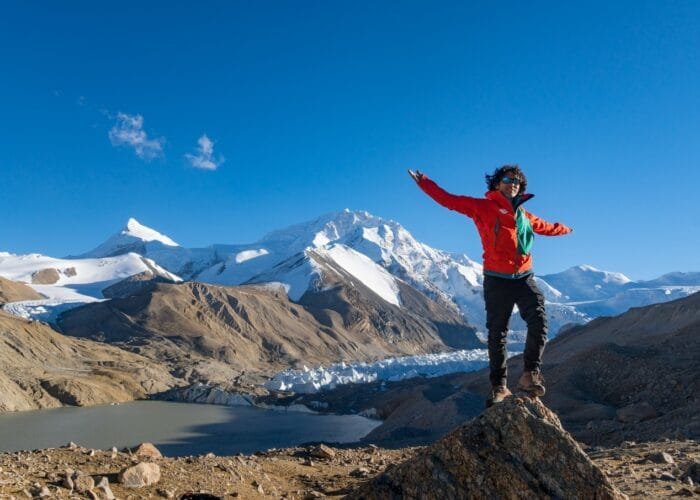
Mount Shishapangma, also written as Shishabangma, is one of the most remarkable giants of the Himalayas. Located in southern Tibet, China, near the Nepal border, this majestic mountain stands at an elevation of 8,012 meters (26,286 feet), ranking 14th among the world’s 14 peaks over 8,000 meters.
What makes Mount Shishapangma truly unique is that it is the only 8,000-meter mountain located entirely within Tibet. All other peaks of similar height are shared by multiple countries, making Shishapangma a special symbol of Tibetan Himalayan geography.
Geographic Location and Surroundings
Mount Shishapangma lies at 85°46′55″ east longitude and 28°21′07″ north latitude, positioned in the central Himalayas. It is located approximately 120 kilometers southeast of Mount Qomolangma (Mount Everest) and sits along the route leading to Kyirong Port, an important border crossing between Tibet and Nepal.
Tibet is home to five peaks above 8,000 meters, and Shishapangma is the westernmost among them. Rising from a vast high-altitude plateau, the mountain dominates the surrounding landscape, even when its summit is hidden behind drifting clouds.
A Mountain Often Veiled in Clouds
Seeing the full silhouette of Mount Shishapangma can be elusive. Clouds often linger around its summit, preventing a complete view of the peak. Yet even when the top remains concealed, the snow line, massive ridges, and powerful presence of the mountain are clearly visible.
On clear stretches of the plateau, the scenery becomes breathtaking—blue skies, floating white clouds, golden alpine meadows, and distant snow-covered peaks combine to create a classic Himalayan landscape. The contrast between open plains and the sudden rise of Shishapangma adds to its quiet but commanding beauty.
Entering the Shishapangma Nature Reserve
The Shishapangma Nature Reserve protects the mountain and its surrounding ecosystem. Weather within the reserve can change rapidly, with clouds rolling in and out throughout the day. When visibility improves, visitors are rewarded with sweeping views of grasslands, glaciers, and snow peaks stretching across the horizon.
This protected area is not only significant for mountaineering but also for its high-altitude ecology, showcasing the raw and untouched character of the Tibetan plateau.
Climbing History of Mount Shishapangma
Compared with other 8,000-meter peaks, Mount Shishapangma was climbed relatively late due to its remote location. Between 1980 and 1990, a total of 107 climbers from 19 teams representing 17 countries successfully attempted the ascent.
By September 2003, records show that 201 climbers had reached the summit, while 19 lives were lost, highlighting the risks involved in high-altitude Himalayan mountaineering.
A tragic event occurred on August 7, 2002, when five members of a Peking University climbing team—Lin Liqing, Yang Lei, Lu Wei, Lei Yu, and Zhang Xingbai—were killed in an avalanche while attempting the summit. This incident remains a solemn reminder of the mountain’s unpredictable and dangerous nature.
Climate Conditions Around Mount Shishapangma
The climate of Mount Shishapangma is very similar to that of Mount Everest, shaped by strong monsoon systems and extreme altitude.
Summer Monsoon Season (June to Mid-September)
During this period, southeasterly monsoons bring heavy rainfall, thick cloud cover, and unstable snow conditions. Frequent storms make climbing extremely difficult.
Winter Season (Mid-November to Mid-February)
Winter is harsh and unforgiving. Temperatures can drop to –60°C, with average temperatures ranging from –40°C to –50°C. Strong northwesterly winds can reach speeds of up to 90 meters per second, creating life-threatening conditions.
Transitional Wind Seasons
- March to May: Strong spring winds dominate before the rainy season begins.
- September to October: The monsoon gradually retreats, giving way to clearer skies and more stable weather.
Best Time for Mountaineering on Shishapangma
The most favorable climbing windows on Mount Shishapangma occur during:
- April and May
- October and November
During these months, climbers can expect 2–3 periods of good weather lasting about two consecutive days, and occasionally 1–2 longer windows of three days or more. These stable weather periods usually appear every 5 to 19 days, making them crucial opportunities for summit attempts.
Because of its relatively accessible routes compared to other 8,000-meter peaks, Shishapangma is often considered an entry point for experienced climbers aiming to step into the world of extreme-altitude mountaineering—though the risks remain very real.