
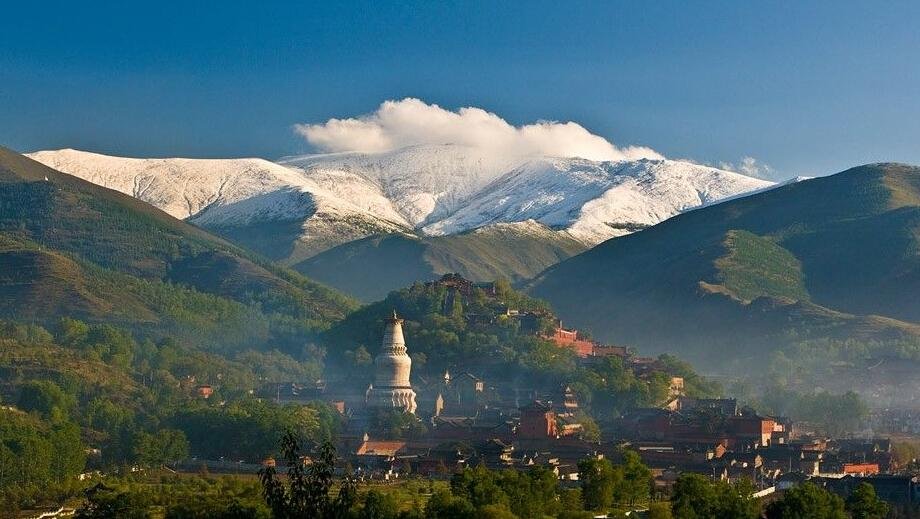
Mount Wutai, located in Shanxi Province, is widely regarded as the foremost of China’s Four Sacred Buddhist Mountains. Revered as the primary bodhimanda (spiritual training ground) of Manjushri Bodhisattva, the embodiment of supreme wisdom, this mountain symbolizes the intellectual and spiritual heart of Buddhism in China.
Unlike other sacred mountains, Mount Wutai is the only Buddhist site where both Han Chinese Buddhism and Tibetan Buddhism coexist harmoniously. Its extraordinary cultural and religious value earned it a place on the UNESCO World Cultural Heritage List in 2009, further cementing its global importance.
Mount Wutai offers not only a sanctuary for spiritual seekers but also a refreshing alpine climate, breathtaking landscapes, and centuries of living Buddhist tradition.
A World of Five Terraces: Understanding Mount Wutai
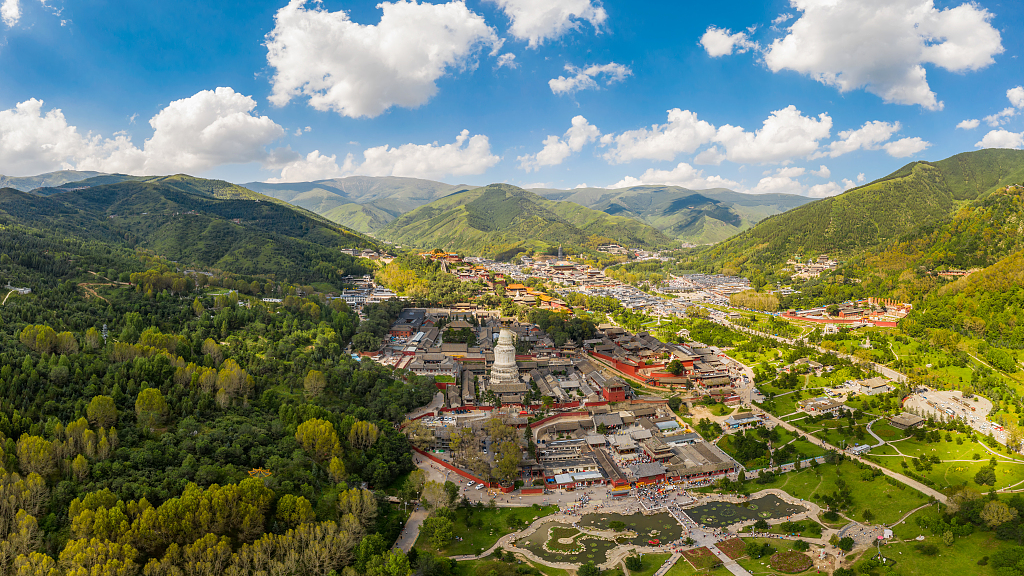
Mount Wutai lies in Xinzhou Prefecture of Shanxi Province, spanning Wutai County, Fanshi County, and surrounding regions. Covering an impressive 2,837 square kilometers, the mountain range is named after its five broad, flat summits that resemble massive stone terraces.
Historically, the mountain has also been called Qingliang Shan, Zifu Mountain, and Lingjiu Peak — names reflecting its spiritual serenity and elevated status in Buddhist cosmology.
The Five Terraces of Mount Wutai
| Terrace | Elevation | Unique Feature | Manifestation of Manjushri |
|---|---|---|---|
| East Terrace (Wanghai Peak) | 2,795 m | Famous for sunrise and sea of clouds | Intelligent Manjushri |
| West Terrace (Guayue Peak) | 2,773 m | Ideal for moon viewing | Lion’s Roar Manjushri |
| South Terrace (Jinxiu Peak) | 2,485 m | Known as the “Sky Garden” filled with rare flowers | Wisdom Manjushri |
| North Terrace (Yedou Peak) | 3,061 m | Highest peak in North China, called the “Roof of North China” | Stainless Manjushri |
| Central Terrace (Cuiyan Peak) | 2,894 m | Vast plateau where the Buddha’s light is sometimes seen | Childlike Manjushri |
The climate here is remarkably cool. Even in midsummer, the average temperature is only about 17°C (63°F) — perfectly matching the description found in the Avatamsaka Sutra, which refers to the dwelling place of great bodhisattvas as a “clear and cool mountain.”
This makes Mount Wutai both a renowned summer retreat and an ideal destination for meditation and long-term spiritual practice.
The Sacred Legends of Manjushri at Mount Wutai
Scriptural Origins of the Bodhimanda
Mount Wutai is mentioned in the extensive Mahayana scriptures taught by Shakyamuni Buddha. In these texts, the Buddha instructs Vajrapani:
“In the northeastern region lies a great land called Maha-China. There is a mountain known as the Five-Peak Mountain. After I pass into nirvana, the Bodhisattva Manjushri, appearing as a youthful prince, will reside there with ease, teaching the Dharma that brings benefit and happiness to all sentient beings. Surrounded by gods, nagas, and the eight classes of powerful spirits, he will be honored and revered.”
Just as this prophecy foretold, during the Zhou dynasty of China, the Venerable Manjushri is believed to have manifested at this supreme sacred site of the Five-Peak Mountain. Over many subsequent dynasties, numerous temples were constructed there, transforming it into a major place of worship. As a result, throughout China the mountain became renowned as the sacred abode of Manjushri Bodhisattva.
The Legend of the Cooling Stone
According to tradition, the mountain was once called Five Peaks Mountain, known for its harsh and unlivable climate. Moved by compassion for suffering beings, Manjushri is said to have borrowed a mystical “Cooling Stone” from the Dragon King of the Eastern Sea. Once placed upon the mountain, the scorching environment transformed into a refreshing sanctuary.
The region was thereafter renamed Qingliang Shan (Cool Mountain), and temples such as Qingliang Temple were established in its valleys.
The Birth of Buddhism at Mount Wutai
In 68 CE during the Eastern Han Dynasty, two Indian monks — Kāśyapa Mātaṅga and Dharmaratna — traveled to Mount Wutai and founded Dafu Lingjiu Temple, the predecessor of today’s Xiantong Temple. This marked one of the earliest introductions of Buddhism into China and began Mount Wutai’s long religious history.
Local monks recount that in ancient periods there were more than 360 monasteries along the mountain range. A booklet published by the Shanxi Provincial Cultural Heritage authorities notes that shortly after cultural revolution, there were 97 Chinese Buddhist monasteries and 23 Tibetan Buddhist monasteries. Even as of 1990, nearly 40 monasteries remained, among which about five or six housed Tibetan and Mongolian monks, including monasteries such as Guangzong Ling and Chnagkya Garwa.
Pilgrimage to the Five Terraces
Each terrace enshrines a distinct manifestation of Manjushri, representing different paths to wisdom. Pilgrims traditionally undertake the journey known as “Chaotai” — the pilgrimage to all five terraces. Completing this circuit is considered a sign of spiritual fulfillment and accumulated merit.
Historical Figures Who Visited Mount Wutai
Mount Wutai has attracted scholars, monks, emperors, and international pilgrims for centuries:
- Xuanzang, the famed Tang dynasty monk, studied Buddhist philosophy here.
- Emperors Kangxi and Qianlong visited multiple times, leaving imperial inscriptions.
- Monks from Japan, India, Mongolia, and Tibet traveled here in search of authentic teachings.
The mountain thus evolved into a global center of Buddhist learning.
Manjushri Bodhisattva: The Embodiment of Supreme Wisdom
Manjushri (Sanskrit: Mañjuśrī), whose name means “Gentle Glory” or “Wonderful Virtue,” is the left attendant of Shakyamuni Buddha and revered as the Teacher of Seven Buddhas.
He represents wisdom not as intellectual accumulation but as direct insight into the true nature of reality — transcending dualistic thinking and leading beings toward liberation.
Core Symbols of Manjushri
- Five Topknots: Represent the Five Wisdoms — ultimate realization beyond attachment.
- Flaming Sword: Cuts through ignorance and illusion.
- Blue Lotus: Symbolizes pure, undefiled wisdom.
- Blue Lion Mount: Embodies fearless intellectual power capable of overcoming false views.
The “Great Wisdom” associated with Manjushri is the penetrating awareness that frees the mind from suffering and reveals ultimate truth.
A Unique Buddhist Landscape: Where Han and Tibetan Traditions Meet
One of Mount Wutai’s most remarkable features is the coexistence of Han Buddhist temples (“Green Temples”) and Tibetan Buddhist monasteries (“Yellow Temples”). Today, the mountain is home to 47 temples, including 12 Tibetan monasteries established under imperial patronage during the Qing dynasty.
Pusa Ding — The Largest Tibetan Monastery
Pusa Ding stands as the most prominent Tibetan Buddhist monastery on Mount Wutai. Emperor Kangxi personally inscribed the plaque reading “Lingfeng Shengjing” (Sacred Peak Realm), highlighting its spiritual prestige.
Architectural Treasures from the Tang Dynasty
Mount Wutai preserves some of China’s oldest surviving wooden structures:
- Foguang Temple
- Nanchan Temple
Often described as “living fossils of Chinese architecture,” these buildings hold immense historical and artistic value.
The “Little Pilgrimage”: Dailuo Summit
Because visiting all five terraces can be physically demanding, many pilgrims opt for the Dailuo Summit, where statues of the Five Manjushris are enshrined together. This journey is known as the “Small Chaotai,” believed to carry spiritual merit comparable to the full pilgrimage.
A Treasury of Buddhist Art
Mount Wutai houses extraordinary artistic heritage:
- Bronze halls and pagodas at Xiantong Temple
- Glazed tile roofs at Pusa Ding
- Ancient murals, sculptures, calligraphy, and stone inscriptions
Together, these masterpieces reflect the brilliance of Chinese Buddhist art across dynasties.
Mount Wutai and Tibetan Buddhism: A Meeting Point of Wisdom Traditions
Arrival and Flourishing
Tibetan Buddhism arrived at Mount Wutai during the Yuan dynasty and reached its peak in the Ming and Qing eras, transforming the mountain into a major northern center for Tibetan teachings.
Influence of the Gelug School
Historical records further describe that Jamchen Chöje Shakya Yeshe, acting as a representative of Je Tsongkhapa, traveled to the imperial court and established six monasteries on the Cool Mountain, thereby initiating the spread of the Gelug teachings in this region.
Many eminent masters later visited this sacred place and practiced here for long periods. Meditation hermitages associated with great figures — including the Dalai Lama Tsangyang Gyatso and Changkya Rolpai Dorje — can still be seen today.
Imperial Patronage
Qing emperors — especially Kangxi and Qianlong — strongly supported Tibetan Buddhism. They funded monasteries, bestowed ritual objects, and granted imperial plaques, elevating Tibetan institutions like Pusa Ding to royal status.
Pilgrimage Routes Linking Tibet and North China
For Tibetan Buddhists, Mount Wutai is one of the most important pilgrimage destinations outside Tibet. Established routes from Tibet, Qinghai, Sichuan, and Mongolia helped strengthen ethnic ties and facilitated centuries of religious exchange.
A Timeline of Han Buddhist History at Mount Wutai
| Period | Key Developments |
|---|---|
| Eastern Han | Construction of Dafu Lingjiu Temple, among China’s earliest Buddhist sites |
| Northern Wei | Emperor Xiaowen designated the mountain as Manjushri’s teaching center |
| Sui–Tang | Over 360 temples built; Mount Wutai became an international pilgrimage destination |
| Song–Yuan | Multiple Buddhist schools coexisted; Tibetan Buddhism introduced |
| Ming–Qing | Deep integration of Han and Tibetan traditions; 47 temples remain today |
| Modern Era | Named a National Scenic Area in 1983 and a UNESCO World Heritage Site in 2009 |
At the heart of this long history lies the enduring faith in Manjushri, a belief that transcends monastic and lay boundaries, ethnic identities, and national borders. This tradition reflects a vision of wisdom that is vast, inclusive, and universally beneficial — reinforcing Mount Wutai’s reputation as a timeless source of enlightenment.
For a more detailed history of this sacred mountain, one may consult classical works such as:
- The Gazetteer of the Five-Peak Mountain by Khenpo Palden Drakpa
- The Gazetteer of the Cool Mountain by Changkya Rolpai Dorje
- Another Gazetteer of Mount Wutai composed by the Mongolian scholar Gonpo Kyab