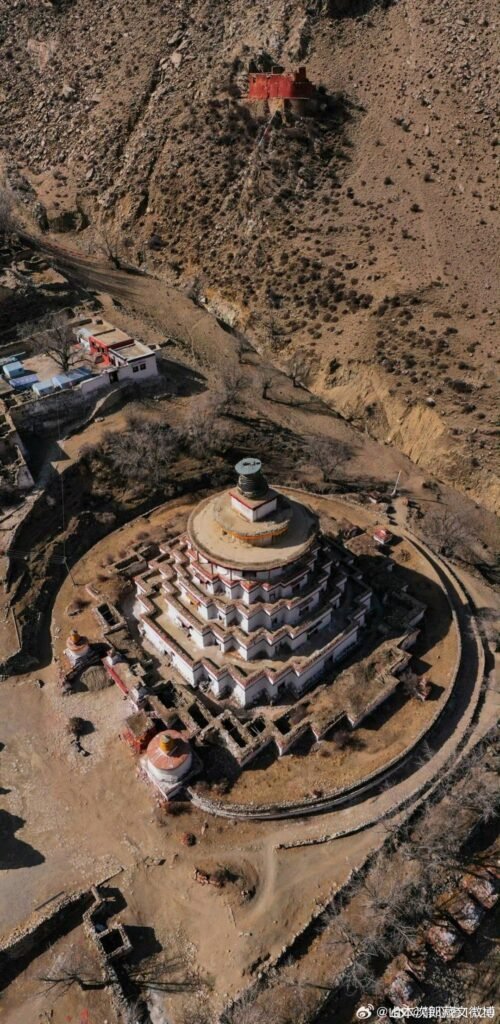
Standing quietly along the legendary 318 National Highway in eastern Tibet, Towa Ritoe Chorten is one of the most spiritually powerful yet lesser-known sacred monuments in the region. Located in Qudeng Township of Mangkang County, Chamdo, this revered white stupa is not only a religious landmark but also the spiritual heart and namesake of the entire township.
In Tibetan belief, Towa Ritoe Chorten is a place where one receives blessings, purification, protection, and happiness simply by visiting. For centuries, it has served as a guardian stupa, watching over travelers, pilgrims, and local communities living along Tibet’s vital eastern corridor.
Meaning of Towa Ritoe Chorten in Tibetan Buddhism
The name Towa Ritoe Chorten (托瓦日珠曲登), also known as Towa Ritoe Fortune White Stupa, carries deep spiritual symbolism:
- Towa Ritoe (藏文音译): “Attaining the Path and Ascending”
- Chorten / Qudeng: The standard Tibetan term for a white stupa
- Full meaning: “The White Stupa of Ascension, Blessings, and Spiritual Attainment”
The word Qudeng (曲登) itself means White Stupa, which is why Qudeng (Chorten) Township derives its name directly from this sacred monument. In the Nyingma tradition of Tibetan Buddhism, Towa Ritoe Chorten is formally recognized as a demon-subduing and spirit-taming stupa, built to stabilize the land and protect all sentient beings.
Location and Sacred Geography
Towa Ritoe Chorten is situated in a highly auspicious landscape:
- Location: Qudeng Township, Mangkang County, Chamdo, Tibet
- Distance: About 105–108 km southwest of Mangkang County town
- Highway: Along the 318 National Highway, west of Jueba Mountain
- Elevation: Qudeng Township averages 3,220 meters above sea level
The stupa stands on Hubashan Hill, a site surrounded by mountains on three sides, where two rivers converge below. In Tibetan geomancy (feng shui), such a location is considered a dragon-gathering land, believed to attract protective deities and positive energies.
Geographically, Qudeng Township marks the western gateway of Mangkang County, bordering:
- Rumei Town to the east
- Zuogong County to the west
- Deqin County, Yunnan to the south
Origins and Legends of Construction
The origins of Towa Ritoe Chorten are surrounded by sacred legend, with two major traditions preserved in local history.
Legend One: The High Masters of the 5th Century
One account traces the construction of the stupa back to the 5th century, when two eminent masters—Jimei Langba and Quji Dawa Zhaba—chose this site to build a demon-subduing fortune stupa. Their intention was to pray for peace and prosperity for all beings of the Snowy Plateau and to pacify disruptive forces in this border region.
Legend Two: Guru Rinpoche’s Divine Blessing
Another widely accepted tradition attributes the stupa to Padmasambhava (Guru Rinpoche), the great tantric master who introduced Vajrayana Buddhism to Tibet. According to this belief, Guru Rinpoche personally blessed—or even constructed—the stupa to suppress demons, seal negative energies, and establish long-lasting auspiciousness.
Early records describe the original structure as primarily wooden, reflecting strong Nyingma treasure (terma) traditions embedded within the site.
Religious Status in Tibetan Buddhism
Towa Ritoe Chorten holds an exceptional position in Tibetan spiritual geography. It is traditionally revered as one of the three most famous and powerful stupas, alongside:
- Boudhanath Stupa in Nepal
- Qudeng Gakong in Deqin County, Yunnan
Together, these stupas form a sacred network of protection and blessing across the Himalayan and Tibetan cultural world.
Within eastern Tibet, Towa Ritoe Chorten is regarded as:
- A guardian stupa for Qudeng Township and the 318 Highway
- An important Nyingma school sacred site
- A spiritual anchor linking nearby holy places such as Niguo Sacred Mountain and Mangcuo Lake
Sacred Features and Miraculous Signs
The Converging Rivers
At the base of the hill, two rivers meet and flow together, symbolizing dragon spirits converging. Locals believe this natural phenomenon confirms the site’s divine protection.
Self-Arisen Sacred Stone
During construction, a self-manifested stone bearing Buddhist markings was reportedly discovered. It is considered a gift from the Buddhas and a powerful relic of blessing.
Imprints of Guru Rinpoche
Some oral traditions maintain that handprints and footprints of Guru Rinpoche are enshrined within the stupa, further enhancing its sanctity.
Symbolism of the Twenty-One Taras
Nearby cypress trees are traditionally believed to represent the transformed hair of Princess Wencheng, echoing legends associated with Riwo Bema Sacred Mountain and reinforcing the site’s feminine compassionate energy.
Architectural Characteristics of Towa Ritoe Chorten
Historically restored multiple times, the stupa follows the classic Tibetan chorten form:
- Whitewashed stupa body, symbolizing purity
- Tiered base, vase-shaped dome, and harmika
- Golden spire crowned with sun, moon, and victory banner
- Inlaid mantras and Buddha images
Surrounding the stupa are:
- Prayer flags fluttering in all directions
- Mani stone piles carved with sacred mantras
- A traditional sang-burning (incense offering) platform
Together, these elements create a complete and living ritual space.
Pilgrimage Traditions and Local Devotion
For the people of Qudeng Township, Towa Ritoe Chorten is the core spiritual center of daily life. During major Tibetan festivals, families gather to circumambulate the stupa, burn incense, offer barley flour, butter lamps, and prayer scarves.
Pilgrims traditionally walk clockwise, completing three or seven circumambulations, numbers considered auspicious in Tibetan Buddhism. The stupa is believed to ward off disasters, ensure safe journeys, and protect travelers along the 318 route.
How to Visit Towa Ritoe Chorten
Getting There
- Self-drive: Follow the 318 National Highway westward. After passing the Jueba Mountain Tunnel (opened in 2024), reach Qudeng Township and follow local signposts.
- Public transport: Take a bus from Mangkang County Bus Station toward Zuogong, get off at Qudeng Township (approx. 2.5 hours), then walk or hire local transport.
- Private car / tour: Chartering a 4WD vehicle from Mangkang allows easy combination with nearby sacred and natural sites.
Best Time to Visit
- Best seasons: April–May (spring blossoms), September–October (clear skies and mountain views)
- Best times of day: Early morning or sunset, when sunlight bathes the white stupa
- Festivals: Saga Dawa, Wangguo Festival, and other Tibetan lunar observances feature traditional pilgrimages
Travel and Pilgrimage Tips
- Always walk clockwise around the stupa
- Do not step on mani stones or touch sacred images
- Prepare for altitude (3,220 m) and avoid sudden exertion
- Protect the environment and keep the site clean
- Wear non-slip shoes, especially in rainy weather
Nearby Sacred and Scenic Sites to Explore
Towa Ritoe Chorten fits naturally into deeper cultural itineraries for international travelers:
- Jueba Mountain & Tunnel – legendary 318 Highway passage
- Niguo Sacred Mountain – major Nyingma pilgrimage center
- Mangtso Lake – high-altitude wetland and bird habitat
- Dameiyong Snow Mountain (Goddess Peak) – visible from Hongla Pass
- Yanjing Salt Fields – ancient hand-made salt production
- Chuzikha Hot Springs – riverside geothermal retreat on the Lancang River