

In the serene shrine rooms of Tibet and Himalaya, the day begins with a simple yet profound ritual: Yönchap (ཡོན་ཆབ་). This practice involves the offering (yön) of water (chab) to sacred recipients, representing a gesture of hospitality and devotion to the Buddhas and Bodhisattvas.
While Buddhist tradition emphasizes giving gifts of great value, water is considered an ideal offering. It is essential for life and intrinsically pure, yet its abundance allows practitioners to practice generosity without the obstacles of pride or attachment to material wealth.
The Historical Origins of Yönchap
Water offerings have been a staple of Himalayan Buddhist practice since the 8th century, but the tradition flourished in the 11th century due to the Indian master Atiśa.
During his travels through the Himalayas, Atiśa was struck by the exceptional purity of the region’s natural springs and rivers. He famously advised that in such a land, water alone was a sufficient material for offering. Following his guidance, the practice of offering water every morning became a cornerstone of daily spiritual life in Tibet and Himalayan.
Materials and the “Eight Qualities” of Water
The quality of the water is of the utmost importance. Tibetan practitioners typically avoid river or stream water, which may be soiled by human or animal activity, preferring instead the “first water” from mountain springs.
Ideally, the water should possess the eight qualities (ཆུ་བོ་ཡན་ལག་བརྒྱད་ལྡན་):
- Cool
- Delicious
- Light
- Soft
- Clear
- Odourless
- Soothing to the throat
- Gentle on the stomach
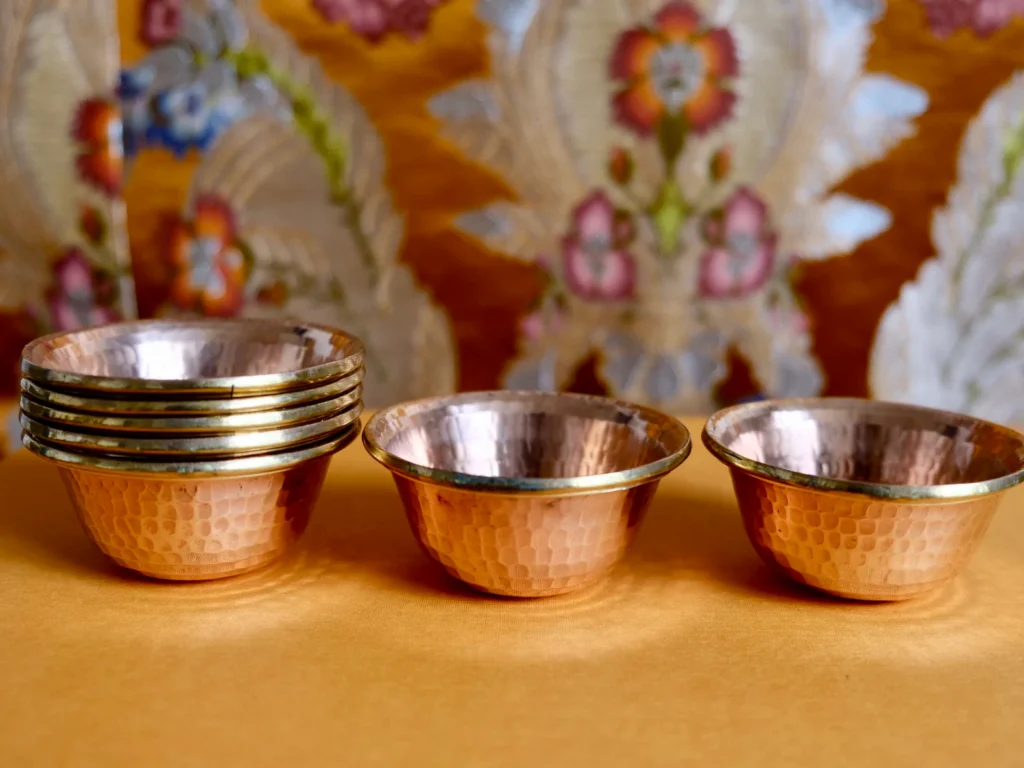
Families often invest in special offering bowls made from silver, bronze, steel, or glass. A dedicated kettle or jug is kept specifically for this purpose, along with a clean cloth to maintain the pristine state of the shrine.
The Symbolism of the Seven Bowls
While the number of bowls can vary, most Tibetan homes use a set of seven bowls. This arrangement is rooted in ancient Indian customs of hospitality, mirroring how a guest would be welcomed into a home.
The seven bowls represent two types of water and five items of basic utility (Nyerspyod Nga), which are traditionally offered to a guest or a deity:
| Order | Offering Item | Tibetan Name | Symbolic Purpose |
| 1 | Drinking Water | Argham | To quench thirst |
| 2 | Washing Water | Padyam | To wash the feet |
| 3 | Flowers | Metog | To delight the eyes |
| 4 | Incense | Dugpö | To please the sense of smell |
| 5 | Butter Lamps | Marmé | To illuminate the darkness |
| 6 | Perfume | Drichab | To refresh the body |
| 7 | Food | Shalzay | To provide sustenance |
By filling these seven bowls with pure water every morning, the practitioner symbolically provides a complete and luxurious welcome to the enlightened beings, even when physical flowers or incense are not available.
The Ritual of Yönchap: A Step-by-Step Guide to Mindful Water Offering
In Tibetan and Himalayan Buddhist traditions, the act of offering Yönchap is more than a daily chore; it is a profound meditative practice. The process requires precision, hygiene, and a focused mind to ensure the offering is both aesthetically pleasing and spiritually potent.
Preparing the Bowls: Setting the Auspices
The ritual begins with seven clean bowls. According to Tibetan masters, the bowls should never be placed on the altar empty, as an empty vessel can symbolize lack or unfavorable outcomes.
- The Stacking Method: Start with the bowls in a clean stack.
- The First Pour: Pour a small amount of water into the top bowl.
- The Sequence: Pour most of that water into the second bowl, then place the first bowl on the far left of the shrine (from the viewer’s perspective).
- The Chain: Repeat this “cascading” method for each bowl until all seven are placed in a row, each containing a small “seed” amount of water to maintain positive auspices.
The Art of Pouring: Precision and Respect
Once the bowls are lined up—perfectly straight and spaced apart by the width of a single grain of barley—the main pouring begins.
- The Technique: Water should be poured in a specific rhythm: slowly at first, then vigorously, and finishing slowly. This prevents splashing and demonstrates a sense of calm and self-control.
- The Posture: To show deep respect, pour using your right hand while supporting your right elbow with your left hand.
- Hygiene: Many practitioners wear a mask to ensure their breath or saliva does not contaminate the purity of the offering.
- The “Golden Mean”: Fill the bowls until there is only a grain’s width of space left at the top. Overfilling suggests excess, while underfilling suggests inadequacy.
Blessing and Concluding the Offering
Once the water is poured, it must be consecrated. Use a clean twig or the top of a ritual vase to flick a few drops of water as a blessing while chanting the sacred syllables: Oṃ Aḥ Huṃ.
These three syllables represent the Body, Speech, and Mind of the Buddhas. They serve to cleanse the water of impurities, transform it into divine nectar, and multiply it so it may reach all sentient beings.
Evening Completion
In the evening, the ritual concludes. The water is poured out and discarded (often used to water plants or poured in a clean place). The bowls are then wiped dry with a dedicated clean cloth and stacked neatly on the shrine until the next morning.
The Meditative Mindset: Cultivating Generosity
The true power of Yönchap lies in the practitioner’s intention. As you pour the water, it is encouraged to hold specific altruistic thoughts:
- Universal Quenching: Visualize that by offering this water, all sentient beings are freed from the suffering of thirst.
- Vast Visualization: Imagine each bowl as the entire world and the water as pure nectar.
- Overcoming Stinginess: Because water is plentiful, you can practice giving it away wholeheartedly, training the mind for the “Perfection of Giving” without the hesitation or attachment often felt with expensive items.
Finally, always dedicate the merit of the practice to the liberation of all beings from every form of suffering.