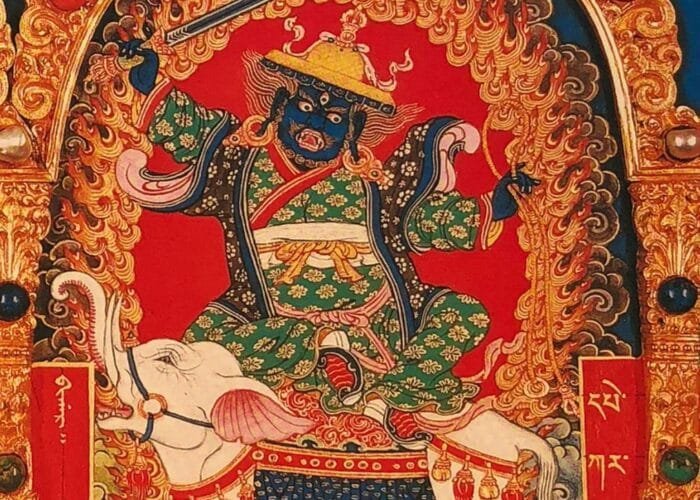
In Tibetan Buddhism, Pehar Gyalpo is one of the most important protector deities. Known as a powerful dharmapala, he is closely connected with Tibetan spiritual protection, monastic traditions, and the famous state oracle system.
His story stretches back to the early history of Tibetan Buddhism and is closely linked with major historical figures such as Trisong Detsen and Padmasambhava.
Over time, Pehar Gyalpo became one of Tibet’s most respected spiritual guardians and an important figure in religious rituals and monastic traditions.
Trisong Detsen’s Quest for Spiritual Protection
During the 8th century, Emperor Trisong Detsen sought strong spiritual protection for Tibet as Buddhism was being established across the region.
According to historical accounts and traditional narratives, an expedition was sent toward the region around Lake Baikal. At that time, powerful spiritual forces connected to Pehar were believed to be held by the Bhata Hor, associated with the Orkhon Uyghur Empire.
Sacred objects connected with Pehar were considered essential for invoking his protective presence.
The Expedition Led by Muney Tsenpo
The mission to retrieve these sacred objects was later carried out by Muney Tsenpo, the successor of Trisong Detsen.
After successfully bringing the sacred artifacts to Tibet, Pehar Gyalpo was formally installed as a protector at Samye Monastery.
Through ritual vows and spiritual ceremonies, Pehar was bound by oath to protect the Dharma and its practitioners. Samye then became known as Nechen, meaning the “Great Place,” where powerful protector forces were believed to reside.
A Mystical Event Near Drepung Monastery
Another story connected with Pehar describes a mysterious event near Drepung Monastery.
A drifting casket discovered near the monastery was said to reveal Pehar’s presence. When the container was opened, his spiritual force was believed to have been released.
Over time, Pehar began manifesting through oracles. During the period of Sonam Gyatso, the protector started appearing through a medium, giving spiritual guidance.
Later, under Ngawang Lobsang Gyatso, this practice was formally established as the State Oracle tradition.
Nechung Monastery and the State Oracle
The center of this oracle tradition became Nechung Monastery.
At Nechung Monastery, the Nechung Oracle serves as the medium through which Pehar Gyalpo is believed to communicate. Through ritual trance states, the oracle provides guidance and protection for religious and national matters.
Because of this role, Pehar Gyalpo became not only a protector of monasteries but also a guardian connected to the spiritual and political traditions of Tibet.
The Five Aspects of Protector Pehar Gyalpo
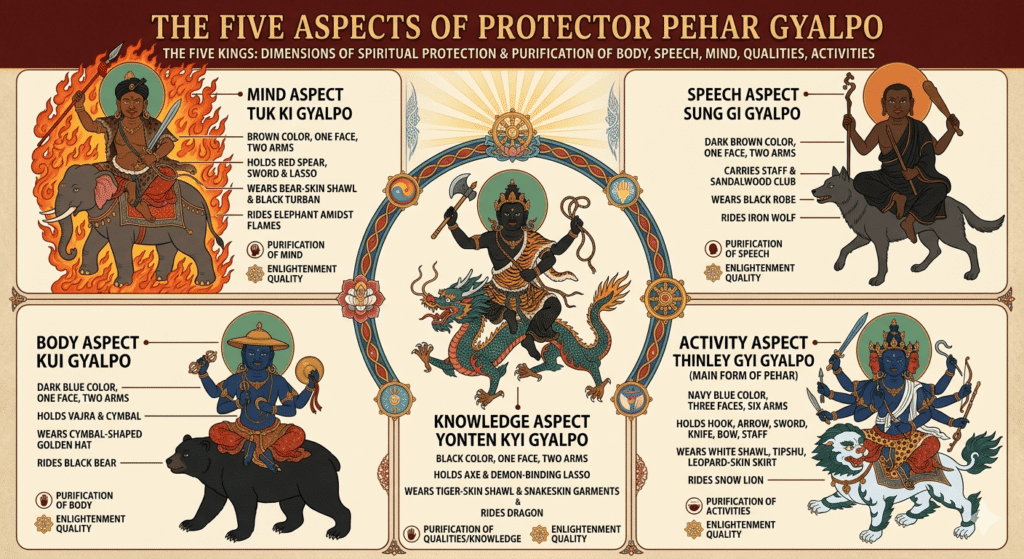
Pehar Gyalpo is often described through five manifestations, known as the Five Kings. These forms represent different dimensions of spiritual protection and correspond to the qualities of enlightenment.
Together, they symbolize the purification and protection of body, speech, mind, qualities, and activities.
Mind Aspect – Tuk ki Gyalpo
The Mind King appears in a brown color with one face and two arms. In his right hand he holds a red spear, while the left carries a double-edged sword and lasso.
He wears a bear-skin shawl and a black turban and rides on an elephant surrounded by blazing flames.
Body Aspect – Kui Gyalpo
The Body King appears dark blue with one face and two arms. His right hand holds a vajra, while the left hand carries a cymbal.
He wears a round golden hat shaped like a cymbal and rides on a black bear.
Knowledge Aspect – Yonten kyi Gyalpo
The Knowledge King is black in color with one face and two arms. He holds an axe in the right hand and a demon-binding lasso in the left.
He wears a tiger-skin shawl and black snakeskin garments and rides a dragon.
Speech Aspect – Sung gi Gyalpo
The Speech King appears dark brown with one face and two arms. In his right hand he carries a staff, while the left holds a sandalwood club.
He is dressed in a black robe and rides an iron wolf.
Activity Aspect – Thinley gyi Gyalpo
The Activity King, often identified as the main form of Pehar, has three faces and six arms and appears navy blue.
His right hands hold a hook, arrow, and sword, while the left hands carry a knife, bow, and staff. He wears a white shawl, tipshu garment, and leopard-skin skirt while riding a snow lion.
Iconography and Symbolism
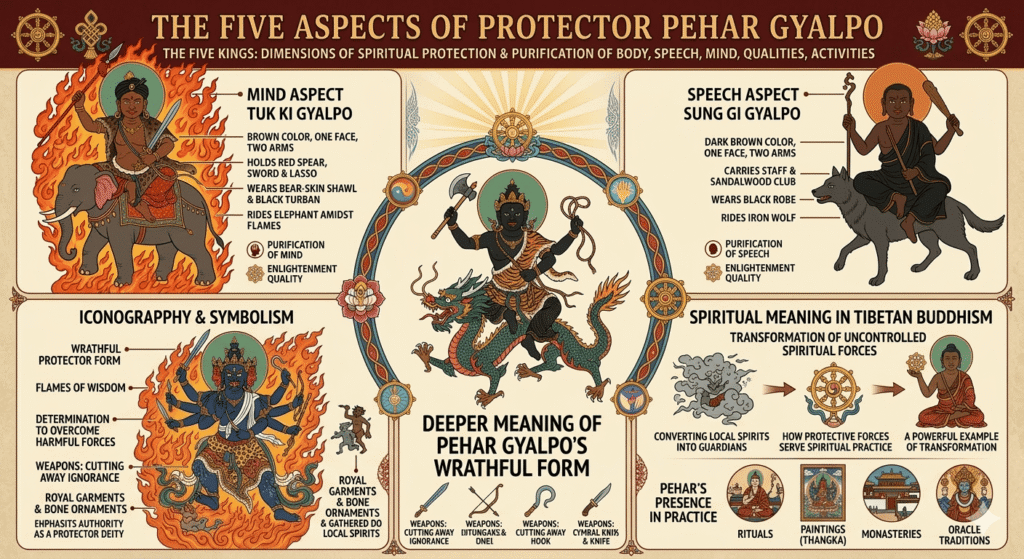
In Tibetan art, Pehar Gyalpo often appears as a wrathful king-like protector surrounded by flames of wisdom.
His powerful form may include multiple arms and fierce expressions, symbolizing the determination to overcome harmful forces. Weapons such as swords, bows, hooks, and knives represent the cutting away of ignorance and the protection of spiritual teachings.
He is usually shown wearing royal garments and bone ornaments, emphasizing his authority as a protector deity.
Spiritual Meaning in Tibetan Buddhism
Pehar Gyalpo represents the transformation of uncontrolled spiritual forces into enlightened protection.
Rather than rejecting local spirits, Tibetan Buddhist tradition often transforms them into guardians of the Dharma through sacred vows and rituals.
Because of this transformation, Pehar became a powerful example of how protective forces can serve spiritual practice and protect both teachings and practitioners.
His presence continues in rituals, paintings, monasteries, and oracle traditions across Tibet, where he remains one of the most recognized protector deities in Tibetan Buddhism.
Reference: www.khandro.net/deity_wrathful_Pehar.html