
Chengdu to Lhasa Train: Complete Travel Guide
The Chengdu to Lhasa train is one of the most fascinating rail journeys in Asia, connecting the vibrant “Land of Giant Pandas” with the mystical Tibetan Plateau. Covering approximately 3,360 kilometers, this railway adventure crosses multiple provinces and showcases dramatic landscapes—from fertile basins to snow-covered mountains.
For travelers seeking a slower, more immersive approach to Tibet, the train offers a memorable alternative to flying. With comfortable sleeper cabins and panoramic views, it’s not just transportation—it’s part of the experience.
Overview of the Chengdu to Lhasa Train Route
Currently, there is one pair of non-bullet trains operating between Chengdu and Lhasa. The journey typically lasts around 36 to 36.5 hours, giving passengers plenty of time to relax, acclimatize gradually to higher altitudes, and enjoy the ever-changing scenery.
Most travelers board the Z322 train at Chengdu Railway Station, one of the city’s major transport hubs.
Key Train Details
| Train No. | Route | Departure | Arrival | Duration | Distance | Hard Sleeper | Soft Sleeper |
|---|---|---|---|---|---|---|---|
| T22 / Z322 | Chengdu → Lhasa | 20:45 | 15:40 (3rd day) | ~42h55m | 3360 km | CNY 689 | CNY 1101 |
| T24 / Z324 | Lhasa → Chengdu | 10:00 | 08:18 (3rd day) | ~46h18m | 3360 km | CNY 689 | CNY 1101 |
Note: Schedules and prices may vary slightly depending on the season.
Because this is a highly popular route for both domestic and international travelers, booking tickets in advance is strongly recommended, especially during peak travel months.
About Chengdu
Chengdu, the capital of Sichuan Province, is one of China’s oldest continuously inhabited cities, founded over 2,000 years ago by the ancient Shu Kingdom. Located in the fertile Sichuan Basin, it grew into a major political and agricultural center, supported by the remarkable Dujiangyan Irrigation System—still in use today—which helped earn the region the title “Land of Abundance.”
During the Tang and Song dynasties, Chengdu flourished as a commercial hub known for silk production and for pioneering early forms of paper money. In modern times, the city expanded rapidly and is now home to more than 20 million people, serving as a key economic and technological powerhouse in western China. Today, Chengdu is globally recognized for its giant pandas, vibrant Sichuan cuisine, UNESCO-listed heritage sites, and its seamless blend of ancient culture with contemporary urban life.
What Makes the Chengdu–Lhasa Train Journey Special?
Taking the train to Tibet is often described as a once-in-a-lifetime travel experience. Unlike flights, which reach Lhasa in just a few hours, the train allows passengers to gradually ascend to high altitude—helpful for reducing the risk of altitude sickness.
Scenic Highlights Along the Route
- Vast grasslands stretching to the horizon
- Snow-capped mountain ranges
- Crystal-clear rivers and alpine lakes
- Remote Tibetan settlements
- Endless skies of the Qinghai-Tibet Plateau
Large train windows make it easy to capture unforgettable photographs, so keep your camera ready.
Other options for traveling from Chengdu to Lhasa

The flight from Chengdu to Lhasa offers an incredible opportunity to witness breathtaking landscapes and immerse oneself in a world of ethereal beauty. As you board the plane in Chengdu, a sense of excitement and anticipation fills the air.
Train vs Flight to Lhasa: Which Is Better?
| Factor | Train | Flight |
|---|---|---|
| Travel Time | Longer journey (typically 30–36 hours from Chengdu) | Much faster (about 2–3 hours) |
| Altitude Adjustment | Gradual acclimatization helps reduce altitude sickness risk | Rapid ascent; acclimatization needed after arrival |
| Scenery | Spectacular plateau landscapes, snow mountains, and vast grasslands | Limited aerial views depending on weather |
| Travel Experience | Relaxed pace with a strong sense of adventure and discovery | Efficient and practical for tight schedules |
| Comfort & Convenience | Comfortable sleeper options but requires more time | Minimal transit time and easy boarding |
| Schedule Flexibility | Fixed departures with fewer daily options | Frequent flights with flexible timings |
| Best For | Travelers seeking an immersive overland Tibet experience | Travelers prioritizing speed and convenience |
✅ Expert Tip: Many seasoned Tibet travelers recommend arriving by train and departing by air to enjoy the scenery while saving time on the return journey.
Top Attractions in Chengdu Before Heading to Tibet
Chengdu is a destination worth exploring before beginning your Tibet journey. The city blends ancient heritage with a modern, relaxed atmosphere.
- Chengdu Research Base of Giant Panda Breeding: Meet China’s most beloved animals in a carefully protected habitat. Arrive early in the morning when pandas are most active.
- Wenshu Monastery and Wenshuyuan Street: A historic Buddhist temple surrounded by tea houses and local snack vendors — perfect for experiencing Chengdu’s slower pace of life.
- People’s Park: Observe daily local culture, from tai chi sessions to lively tea gatherings and traditional matchmaking corners.
- Jinli Ancient Street: A charming pedestrian lane styled after the Qing Dynasty, filled with handicrafts, street food, and Sichuan opera performances.
- Leshan Giant Buddha and Mount Emei: Popular day trips featuring the world’s largest stone Buddha and one of China’s most sacred Buddhist mountains.
- Dujiangyan Irrigation System: An ancient engineering masterpiece that continues to support agriculture more than two millennia after its construction.
Other notable destinations include Jiuzhaigou Valley, Huanglong National Park, Wuhou Temple, and the fascinating Sanxingdui Museum.
The best season to go to Tibet
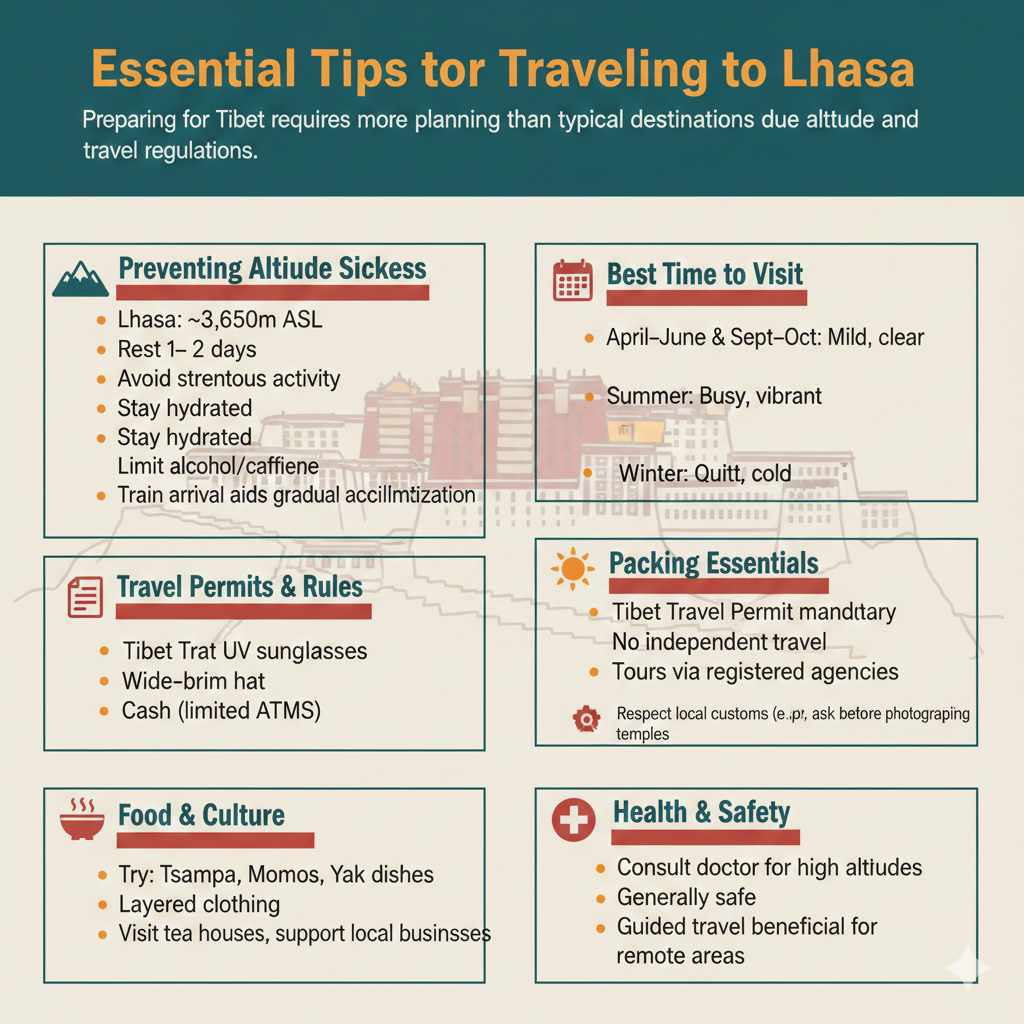
The ideal time to visit Tibet is from March to November. June, July, and August are the busiest months for tourists and prices are higher during this peak season. April, May, September, or October are the most favourable months to travel to Tibet.
What to prepare for a trip to Tibet:
- Take medicine with you. It is recommended to take gastrointestinal medicine, cold medicine, commonly used anti-inflammatory drugs, car sickness drugs, headache powder, analgesic tablets, and some band-aid.
- For clothing, the temperature in Tibet has a huge difference between day and night time, You need to prepare sweaters and woollen pants also. You can take a fleece jacket and a thick storm suit if you are travelling to Mount Everest or Nagri region. You can wear outdoor low-top casual shoes and a long-brimmed hat to shade the sun.
- Article class UV proof sunglasses, sunscreen, umbrella, camera, with a mobile phone standby
Future Sichuan–Tibet Railway: A Game Changer
Although the straight-line distance between Chengdu and Lhasa is about 1,250 km, the current train detours through Qinghai, resulting in a much longer journey. The upcoming Sichuan–Tibet Railway is set to transform travel in western China by reducing travel time to roughly 13 hours.
Planned Route Highlights
The future high-speed railway will pass through several remarkable destinations:
- Chengdu – Famous for pandas, tea culture, and Sichuan cuisine
- Ya’an – Known for lush landscapes and historic tea routes
- Garze (Ganzi) – A vibrant Tibetan region with glaciers and grasslands
- Chamdo – Rich in monasteries and cultural heritage
- Nyingchi – Often called the “Switzerland of Tibet” for its forests and alpine scenery
This new line promises a faster yet equally scenic journey, making Tibet more accessible than ever before.
Why the Chengdu to Lhasa Train Is Worth Experiencing
The train ride from Chengdu to Lhasa is far more than a simple transfer—it’s a journey through shifting cultures, landscapes, and elevations. From panda-filled bamboo forests to the vast Tibetan Plateau, every kilometer reveals something new. Whether you’re drawn by adventure, spirituality, photography, or cultural exploration, this legendary railway route sets the stage for an unforgettable Tibet experience.
Life On Board the Chengdu to Lhasa Train
Like all trains heading toward Tibet, the Chengdu to Lhasa train is specially engineered for high-altitude travel. Modern technology ensures that passengers remain comfortable even as the train climbs onto the world-famous Tibetan Plateau.
High-Altitude Features and Amenities
Passengers can expect several thoughtful onboard facilities, including:
- Advanced air-conditioning systems
- Continuous oxygen supply to help with altitude adjustment
- Real-time altitude display
- Pressurized cabins to maintain stable air conditions
- Double-paned windows with UV filters for protection from strong plateau sunlight
The train is also carefully sealed to maintain interior air quality, creating a safer and more relaxing environment for long-distance travel.
Beyond the technical features, what truly sets this journey apart is the scenery. The Chengdu–Tibet railway route is widely admired for its dramatic landscapes, making the ride itself a highlight of any Tibet itinerary.
Chengdu West Railway Station for the Lhasa Train
Travelers heading to Tibet should note that the train to Lhasa departs from Chengdu West Railway Station (成都西站), located on Jinhui Road in Qingyang District. This modern station is one of Chengdu’s four major rail hubs and serves as a key gateway for routes connected to the Sichuan–Tibet corridor, including the Z-series trains designed for high-altitude travel.
Important Note for Travelers
Some older travel resources still mention Chengdu Railway Station (North Station) as the departure point. However, current services to Lhasa primarily operate from Chengdu West, so always verify your ticket details before departure. The station features modern facilities, efficient boarding procedures, and excellent connectivity to the rest of the city.
How to Travel to Chengdu West Railway Station
Thanks to Chengdu’s advanced transportation network, reaching the station is straightforward whether you’re arriving from the airport or downtown.
| Starting Point | Transport Mode | Route / Instructions | Travel Time | Estimated Cost |
|---|---|---|---|---|
| City Center (Tianfu Square) | Metro | Take Line 1 to a transfer station (e.g., Luomashi), then switch to Line 4 directly to Chengdu West. | 15–25 minutes | ¥3–5 |
| Chengdu Shuangliu International Airport (CTU) | Metro | Take Line 10 to Taipingyuan Station, then transfer to Line 7 or continue via bus/taxi. | 30–45 minutes | ¥5–10 |
| Taxi | Direct ride to the station. | 20–30 minutes | ¥50–80 | |
| Chengdu Tianfu International Airport (TFU) | Metro | Ride Line 18 toward central Chengdu, then transfer to Line 4 or 9 for Chengdu West. | 30–60 minutes | — |
| Taxi | Direct trip depending on traffic. | 45–60 minutes | ¥100–150 | |
| Other Options | Bus / Airport Shuttle | Connect to major transit hubs for onward metro travel. | Varies | Affordable |
✅ Travel Tip: Arrive 1–2 hours before departure to allow time for security checks and Tibet Travel Permit verification. If traveling with heavy luggage, a taxi or rideshare may offer greater comfort.
Alternatives to the Chengdu–Lhasa Train
Due to the popularity of the Qinghai–Tibet Railway, securing tickets during peak season can be challenging. Fortunately, there are practical alternatives.
Travel via Xining
Xining is considered the true starting point of the Qinghai-Tibet railway and offers:
- Multiple daily departures to Lhasa
- Greater ticket availability
- Larger passenger capacity
You can either fly or take a train from Chengdu to Xining, then continue your journey to Tibet by rail.
A Smart Time-Saving Strategy
While some travelers enjoy the full overland experience, others may find the extended train duration exhausting. Since many of the most spectacular landscapes appear between Golmud and Lhasa, a popular strategy is:
👉 Fly from Chengdu to Xining, then take the train to Lhasa.
This approach saves time while still allowing you to experience the most scenic section of the Tibet railway.
Tibet Travel Permit: Essential for Boarding the Train
If you plan to travel to Tibet, obtaining a Tibet Travel Permit is mandatory. This document is separate from your Chinese visa and is required before boarding any train or flight to Lhasa.
Key Things to Know
- You may reserve tickets before receiving the permit, but you cannot board without it.
- Independent travel is not permitted for foreign visitors.
- You must book your trip through a registered Tibet travel agency, which will handle the permit application.
Typically, agencies secure the permit a few days before departure and deliver it directly to your hotel in Chengdu. A photocopy is usually accepted for train boarding. Applying early and providing accurate personal information helps avoid delays or rejection. Once approved, the reward is immense — a journey filled with cultural discovery, spiritual depth, and some of Asia’s most extraordinary landscapes.

To explore Tibet by train, you need a Tibet travel permit. This permit is crucial and different from a Chinese visa. To obtain it, book a tour with a registered travel agency in Tibet. They will assist with the application process and provide knowledgeable guides. Apply in advance with accurate personal information to avoid rejection.
Window Views You Can Expect on the Tibet Train
The scenery along the Tibet railway rivals the world’s greatest train journeys. As the train moves past Xining and into Golmud, the environment transforms dramatically.
Prepare your camera for unforgettable sights such as:
- Qarhan Salt Lake – A dazzling white expanse under endless skies
- Yuzhu Peak – A majestic snow-covered summit
- Kekexili Nature Reserve – Home to rare wildlife and untouched wilderness
- Tuotuo River – One of the headwaters of the Yangtze
- Tanggula Pass – Among the highest railway points on Earth
- Tsonag Lake – Often visible just meters from the tracks
- Qiangtang Grasslands – Vast and windswept
- Namtso Lake – One of Tibet’s most sacred lakes
Few journeys offer such a rapid shift from urban landscapes to remote alpine beauty.

Riding the Qinghai-Tibet train is an unforgettable experience. The train is designed for high altitudes and offers breathtaking views. For more information on the scenery, Please check here.
Travel Tips for Catching Your Train
A smooth departure starts with good preparation. Follow these tips to avoid last-minute stress:
- Verify your train ticket and confirm the correct station.
- Arrive at least 30–60 minutes before departure.
- Boarding typically opens 30 minutes prior, while gates close about 5 minutes before departure.
- Monitor real-time displays for platform updates.
- Queue for ticket inspection or scan your ticket at the turnstile.
- Present your ticket to the attendant before entering your carriage.
Being punctual is essential—trains in China depart precisely on schedule.
Important Notes Before You Travel
- Train schedules are subject to change and should be used as reference only.
- Foreign travelers must obtain a Tibet Entry Permit before purchasing tickets. Ticket-only services are not available.
- Tibet train tickets sell out quickly — it is wise to plan 3–5 months in advance.
- Tickets from major cities are limited; consider flying to Xining for better availability.
- The official ticket platform is www.12306.cn, which operates primarily in Chinese, so assistance from a Chinese speaker may be helpful.
For a smoother experience, many travelers choose to book a guided Tibet tour that includes transportation arrangements.
Arrival at Lhasa Railway Station
Lhasa Railway Station (拉萨站) sits at an elevation of about 3,641 meters in Doilungdêqên District, roughly 5–10 km southwest of downtown Lhasa and the iconic Potala Palace.
Station Features
- Modern design with Tibetan architectural elements
- Three levels and multiple tracks
- Serves trains from major Chinese cities
Transportation from the Station
- Taxi: About ¥30–40 to the city center
- Public buses: Routes such as No. 1, 13, 14, and 30 (around ¥1)
- Tour pickups: Typically a 20–25 minute drive
For those continuing onward, Gonggar Airport is approximately 51 km away, reachable in about an hour by taxi or shuttle.
Arrive early for exit procedures and permit checks, particularly during busy travel seasons.