
Traveling to Lhasa by train is one of the most iconic journeys in the world, and the Xining to Lhasa train route is widely regarded as the most authentic and practical option. While trains to Lhasa also depart from major cities like Beijing, Shanghai, and Chengdu, the true heart of the Qinghai-Tibet Railway begins in Xining.
Each year, nearly one-third of all travelers to Tibet choose the Xining–Lhasa train, making it the most popular railway route to the Roof of the World. The journey combines comfort, safety, and unforgettable plateau scenery, all within a single day.
Why the Qinghai-Tibet Train Starts from Xining
Xining, the capital of Qinghai Province, is the official starting point of the Qinghai-Tibet Railway, the world’s highest railway line. From here, the train climbs steadily onto the Tibetan Plateau, crossing vast grasslands, snow-capped mountains, and pristine lakes before reaching Lhasa.
Unlike trains from Beijing or Shanghai, which take several days, the Xining to Lhasa train journey lasts approximately 21 hours, offering a more direct and efficient way to reach Tibet while still enjoying the most scenic sections of the route.
Fastest Railway Access to Lhasa
One of the biggest advantages of traveling from Xining is speed.
- Xining is the closest major railway hub to Lhasa
- The full journey takes around one day
- Passengers experience the most dramatic plateau landscapes without long transit times
Because the train departs directly from the Qinghai-Tibet Plateau region, altitude gain is more gradual, which many travelers find helpful when adjusting to Tibet’s high elevation.
Designed for High-Altitude Comfort and Safety
The Xining–Lhasa train is specially designed for high-altitude travel, making it one of the safest and most comfortable ways to enter Tibet.
Key onboard features include:
- Pressurized carriages to reduce altitude discomfort
- Oxygen supply systems and oxygen altimeters available throughout the train
- Sealed cabins to maintain stable air pressure
- UV-protected windows that filter strong ultraviolet radiation on the plateau
These features make the journey suitable for first-time visitors to Tibet, especially those concerned about altitude sickness.
Xining to Lhasa Train Schedule (Approximate for 2026)
There are usually 5–6 trains daily, mostly Z-series overnight sleeper trains, departing from Xining Railway Station and arriving at Lhasa Railway Station. Some run daily, while others operate every other day.
| Train No. | Origin | Departure (Xining) | Arrival (Lhasa) | Duration | Frequency | Key Stops |
|---|---|---|---|---|---|---|
| Z8981 | Xining | 12:50 | 10:20 (next day) | 21h 30m | Daily | Delingha, Golmud, Nagqu |
| Z8991 | Xining | 21:50 | 17:39 (next day) | 19h 49m | Daily | Delingha, Golmud, Nagqu |
| Z323 | Chengdu | 11:55 | 07:41 (next day) | 19h 46m | Every other day | Lanzhou, Xining, Golmud |
| Z223 | Chongqing | 11:55 | 07:41 (next day) | 19h 46m | Every other day | Similar stops |
| Y917 | Xining | 16:40 | 14:02 (next day) | 21h 22m | Every other day | Varies |
| Z165 / Z265 | Xi’an / Shanghai | Varies | Next day | 20–22h | Daily / Alternate | Lanzhou, Xining, Golmud |
Schedules may change; always check the latest timetable before travel.
Xining to Lhasa Train Ticket Prices (Approximate)
Ticket prices vary by season and demand.
- Hard Seat: 224–250 CNY
- Hard Sleeper: 495–500 CNY
- Narrower bunks, less privacy
- Soft Sleeper: Around 781 CNY
- More spacious, quieter, and comfortable
For long-distance plateau travel, soft sleeper tickets are strongly recommended.
Booking Tips and Travel Advice
- Tickets can be booked via 12306.cn or through licensed travel agencies
- Tickets are released up to 60 days in advance
- Summer and holiday seasons sell out quickly
- Foreign travelers must have a Tibet Travel Permit, arranged through a tour operator
- Bring snacks and drinks; dining car meals are basic
- Spend time acclimatizing in Xining before traveling to Lhasa to reduce altitude sickness risk
Stunning Scenery Along the Qinghai-Tibet Railway
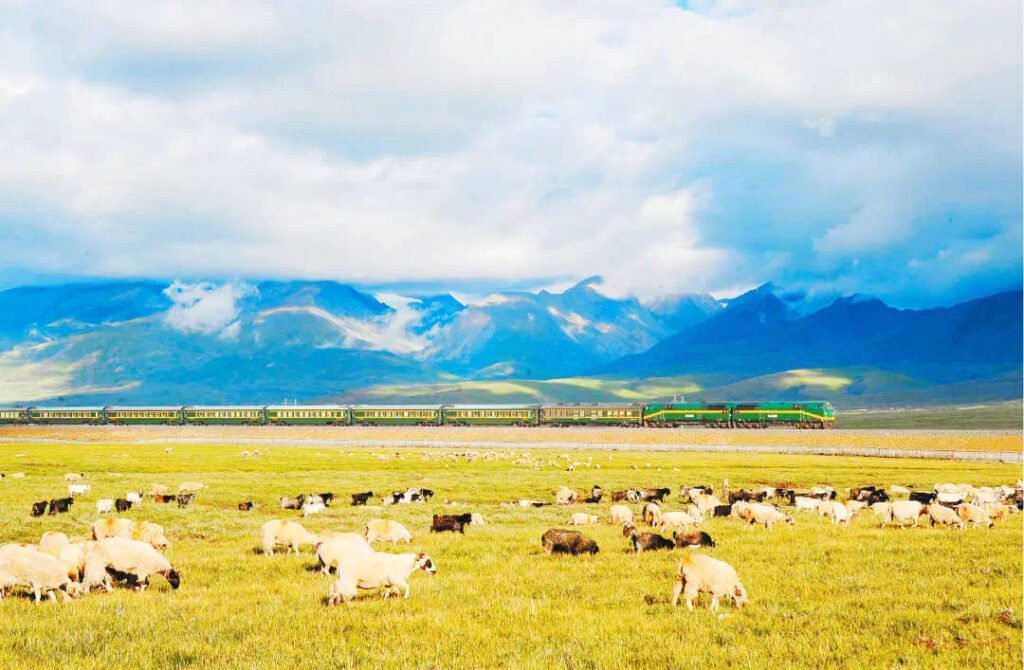
One of the main reasons travelers choose the Xining to Lhasa train is the scenery. The route passes through some of the most untouched landscapes in China.
Highlights visible from the train windows include:
- Endless grasslands of the Qinghai-Tibet Plateau
- Snow-covered mountain ranges
- High-altitude lakes shimmering under clear skies
- Grazing yaks and nomadic settlements
- Vast, open skies that feel completely different from lowland China
The slow, steady pace of the train allows passengers to fully enjoy these views, making the journey itself a major part of the Tibet travel experience.
High Transportation Capacity from Xining
Another major benefit of starting your Tibet train journey in Xining is availability.
- Xining operates three trains to Lhasa daily
- Each train carries 1,000+ passengers
- Total capacity is three times higher than departures from Beijing or Shanghai
During peak travel seasons, especially summer, getting Qinghai-Tibet train tickets from Xining is significantly easier compared to other cities. This makes Xining the most practical departure point for travelers with limited time or fixed itineraries.
Xining to Lhasa Train Schedule Overview
The Xining to Lhasa train service runs regularly throughout the year, with multiple departures each week. While exact departure times may vary by season and demand, the route remains one of the most stable and reliable ways to reach Tibet by rail.
Key schedule details:
- Average travel time: approximately 21 hours
- Multiple weekly departures
- Seasonal adjustments based on travel demand
Because schedules can change, it is always recommended to check the latest train timetable in advance, especially during high season.
A Popular and Convenient Way to Reach Tibet
Among all transportation options to Tibet, the train from Xining to Lhasa remains one of the most popular and convenient choices. It balances speed, comfort, scenic value, and ticket availability better than any other railway route.
For travelers who want to experience the legendary Qinghai-Tibet Railway without spending several days onboard, starting from Xining offers the perfect balance between efficiency and adventure.
Xining Railway Station: Gateway to Tibet by Train
Xining Railway Station (西宁站) is the main railway hub of Qinghai Province and the official starting point of the Qinghai-Tibet Railway. First built in 1958, the station has undergone several expansions and is now the largest railway station on the Tibetan Plateau.
It serves both high-speed and conventional trains, connecting Xining with major cities such as Beijing, Shanghai, Xi’an, Lanzhou, and Lhasa. For travelers heading to Tibet, this station is an essential transit point.
Location and Accessibility
- Address: No. 128 Huzhu Middle Road, Chengdong District, Xining, Qinghai Province
- Distance from downtown: approximately 6 km
- Distance from Xining Caojiabao International Airport: approximately 28 km
The station is easily accessible by taxi and public transportation.
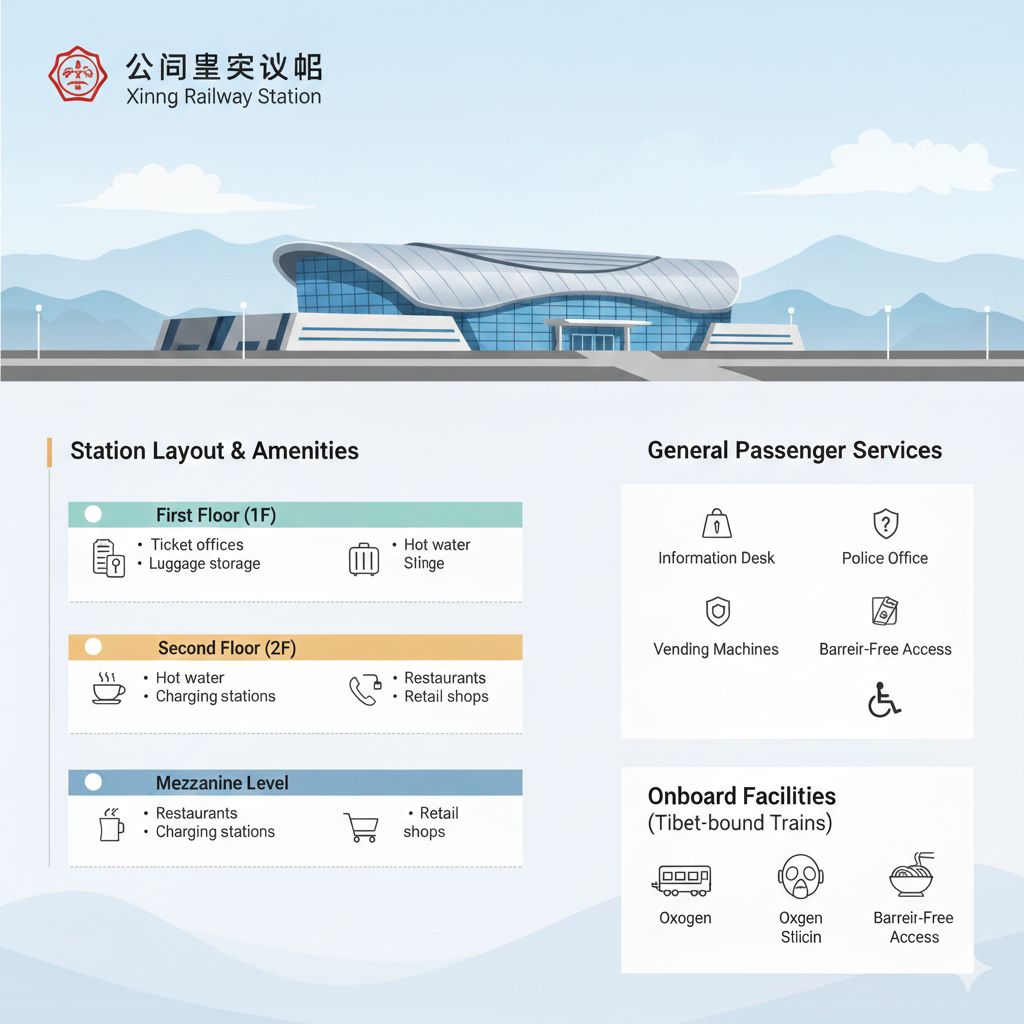
Facilities Inside Xining Train Station
Xining Railway Station features a modern three-story terminal designed to handle large passenger volumes.
A Key Railway Junction in Western China
Xining Railway Station serves as a junction for several major rail lines, including:
- Lanzhou–Qinghai Railway
- Lanzhou–Xinjiang Railway
- Qinghai-Tibet Railway
The station accommodates both bullet trains and regular long-distance trains, reinforcing Xining’s position as the most important railway gateway to Tibet.
How to Travel to Xining Railway Station
Xining Railway Station is conveniently located and easy to reach from both the city center and the airport. As the main departure point of the Qinghai-Tibet Railway, it is well connected by taxi, public transport, and metro, making transfers smooth for Tibet-bound travelers.
From Xining International Airport (XNN) to Xining Railway Station
Distance: ~28 km
Travel Time: 40 minutes–1.5 hours (depending on transport mode)
| Transport Mode | Details | Cost (CNY) | Travel Time | Best For |
|---|---|---|---|---|
| Taxi | Available 24/7 at airport arrival area | 50–80 | ~40 minutes | Convenience, heavy luggage, late-night arrivals |
| Airport Shuttle Bus | Shuttle Line 3 to Xining Railway Station or nearby hotels | 20–25 | ~1 hour | Budget travelers, daytime arrivals |
| Public Bus | Bus 702 to Tangdao, then transfer | Under 10 | ~1.5 hours | Budget travelers with light luggage |
| Private Transfer / Ride-Hailing | Didi (China’s Uber equivalent), app-based payment | 40–60 | ~40–50 minutes | Cashless, flexible, door-to-door travel |
From Xining City Center to Xining Railway Station
Distance: ~5–6 km
Travel Time: 15–40 minutes
Popular Areas: Central Square, Dongguan Mosque
| Transport Mode | Details | Fare (CNY) | Travel Time | Notes |
|---|---|---|---|---|
| Taxi | Easily available citywide | 15–25 | 15–20 minutes | Fast and convenient |
| Public Bus | Routes: 1, 9, 16, 22, 31, 40, 702 | 1–2 | 20–40 minutes | Very economical |
| Metro | Xining Metro Line 1 (opened 2021) | 2–4 | ~15–25 minutes | Direct stop at Xining Railway Station |
| Walking / Biking | Suitable within 2 km | Free | Varies | Not recommended with luggage |
Important Arrival Tips for Tibet-Bound Trains (Xining–Lhasa Route)
| Recommendation | Reason |
|---|---|
| Arrive 1–2 hours early | Stations can be crowded, especially during peak seasons |
| Allow extra time for | Security checks, ticket verification, Tibet Travel Permit inspection, boarding queues |
| Peak season caution | Overnight sleeper trains are especially busy |
Top Attractions to Visit in Xining Before Tibet
Spending time in Xining helps with acclimatization and offers rich cultural experiences.
Must-See Places in Xining
- Qinghai Lake (Koko Nor): China’s largest inland saltwater lake, famous for turquoise waters and summer rapeseed fields
- Ta’er Monastery (Kumbum): Birthplace of Tsongkhapa and an important Gelugpa Buddhist site
- Dongguan Mosque: The largest mosque in Qinghai, near the Muslim food street Mojiajie
- Chaka Salt Lake: Known as the “Mirror of the Sky,” ideal for photography
- Museum of China Tibetan Medicine Culture: Home to the world’s longest thangka
- Sun & Moon Mountain (Riyue Shan): Historic Silk Road mountain pass
- Xining Wildlife Park: Features Tibetan plateau wildlife
Brief History and Introduction of Xining
Xining, the capital city of Qinghai Province in western China, sits in a fertile mountain basin along the Huang River, a tributary of the Yellow River. Located at an elevation of around 2,200 meters, Xining is the largest city on the Tibetan Plateau, with a population of more than 2 million people. Today, it functions as an important political, economic, and cultural center of northwest China.
Because Xining is the official starting point of the Qinghai-Tibet Railway, it is widely known as the “Gateway to the Tibetan Plateau.” Nearly all travelers heading to Tibet by train pass through this city, making it a crucial hub for Tibet-bound journeys.
Strategic Location on Ancient Trade Routes
Xining lies approximately 95 kilometers east of Qinghai Lake (Koko Nor) and about 200 kilometers west of Lanzhou, the capital of Gansu Province. This strategic location placed Xining on important ancient trade routes, including branches of the Northern Silk Road’s Hexi Corridor.
For over two thousand years, Xining served as a key commercial center, handling goods such as wool, salt, timber, and animal products, linking Central China with the Tibetan Plateau and Central Asia.
Over 2,100 Years of Recorded History
Xining’s documented history dates back more than 2,100 years to the Han Dynasty (206 BCE–220 CE), when it was established as a frontier county to manage and control local Qiang tribes. Due to its frontier position, the city played a crucial defensive role during the Han, Sui, Tang, and Song dynasties, acting as a military stronghold against nomadic incursions.
During the 7th and 8th centuries, Xining became a battleground between Chinese dynasties, the Tuyuhun Kingdom, and Tibetan forces. In 763 CE, Tibetan troops briefly occupied the city, then known as Qingtangcheng. The city was later reclaimed by the Song Dynasty in 1104, when it was renamed Xining, meaning “Peace in the West.”
Xining officially became part of Qinghai Province in 1928 and gained full municipal status in 1944, marking its modern administrative development.
A City of Ethnic and Religious Diversity
Xining is one of the most ethnically diverse cities on the Tibetan Plateau. Its population includes Han Chinese, Tibetans, Hui Muslims, Mongolians, and other ethnic groups. This diversity is reflected in the city’s culture, cuisine, festivals, and religious sites.
Key religious landmarks include:
- Dongguan Mosque – one of the most important Islamic sites in northwest China
- Ta’er Monastery (Kumbum Monastery) – a major center of Tibetan Buddhism and a sacred site of the Gelug (Yellow Hat) School
These landmarks make Xining both a spiritual and cultural crossroads between Tibetan, Islamic, and Han Chinese traditions.
Modern Development and Pleasant Climate
Since the 1950s, Xining has experienced rapid industrial development. Major industries include hydroelectric power, coal mining, metallurgy, machinery manufacturing, chemical production, wool processing, and leather tanning.
The city is well connected by highways to Lanzhou and Lhasa, and by railways to major Chinese cities, strengthening its role as a transportation hub.
Xining’s climate is another attraction. Summers are mild, with July and August temperatures averaging between 15°C and 20°C, making it a popular destination for travelers escaping extreme heat in other parts of China.
Xining Today: Modern City Meets Plateau Culture
Modern Xining blends urban life with traditional plateau culture. Contemporary shopping districts, restaurants, and infrastructure coexist with ancient monasteries, mosques, and ethnic neighborhoods. Nearby natural attractions such as Qinghai Lake further enhance its appeal as both a travel destination and a transit city for Tibet travelers.
Practical Tips for Traveling to Lhasa
Permits and Planning
- Tibet Travel Permit must be secured 15–20 days in advance
- All foreign travelers must join a guided tour
- Train or flight tickets are usually included in tour arrangements
Altitude Sickness Prevention
- Acclimatize in Xining for 2–3 days
- Drink plenty of water
- Avoid alcohol and strenuous activity initially
- Oxygen is available on trains and in many hotels
- Medication such as Diamox may help (consult a doctor)
Packing and Health
- January temperatures can drop to -10°C at night
- Pack warm layers, sunscreen, sunglasses, and a hat
- Bring snacks; train dining options are basic
- Cashless payments are common; English is limited—use translation apps
Arrival at Lhasa Railway Station
Lhasa Railway Station is the terminus of the Qinghai–Tibet Railway and one of the highest major railway stations in the world.
- Opened: 2006
- Elevation: 3,641 meters
- Location: Liuwu New Area, about 8 km southwest of Potala Palace
- Facilities: Waiting halls, shops, restaurants, luggage storage, ATMs, accessibility services
Transfers from Lhasa Train Station
- Taxi: CNY 30–40, 10–20 minutes to downtown
- Bus: Routes 1, 13, 14, 30 (CNY 1, about 30 minutes)
- Airport shuttle: To Gonggar Airport (about 60 km, 1 hour)
Passengers are advised to arrive 1–2 hours early for security and document checks, especially during festival seasons.
Tibet Travel Permit Is Mandatory for the Xining–Lhasa Train
If you plan to travel from Xining to Lhasa by train, the Tibet Travel Permit (TTP) is a mandatory document. While you may be able to book a train ticket without the permit, you cannot board the train without it.
Independent travel is not allowed in Tibet for foreign travelers. Backpackers and solo travelers must book through a licensed Tibet travel agency, which will handle the Tibet Travel Permit application on your behalf.
The permit and your train ticket will be checked during check-in and boarding at Xining Railway Station. A photocopy of the Tibet Travel Permit is accepted in Xining, making the process more convenient.
How to Obtain the Tibet Travel Permit
The Tibet Travel Permit is different from a Chinese visa and must be applied for separately.
Key Points to Know:
- You must book a tour with a registered Tibet-based travel agency
- The agency submits your permit application to local authorities
- Accurate personal information is essential to avoid delays or rejection
- The permit is usually approved a few days before departure
- Once issued, the agency will deliver the permit to your hotel in Xining
In most cases, travelers receive their permit just in time for the journey, which is normal and expected.
Why the Tibet Travel Permit Is Worth It

Once approved, the Xining–Lhasa train journey becomes one of the most rewarding travel experiences in the world. The gradual ascent, serene landscapes, and cultural immersion offer:
- Time for quiet reflection
- A sense of tranquillity at high altitude
- Deep exposure to Tibetan culture and spirituality
The permit may require advance planning, but the experience of exploring Tibet’s natural beauty and sacred sites makes it truly worthwhile.
How to Travel to Lhasa from Xining
Xining is the main gateway to Lhasa and the starting point of the legendary Qinghai–Tibet Railway. Thanks to its lower altitude and excellent transport links, Xining allows travelers to reach Tibet with a more gradual altitude gain, reducing the risk of altitude sickness.
There are three main ways to travel from Xining to Lhasa: by train, by flight, or by overland drive. The distance is approximately 1,956 km by rail, about 2,200 km by road, and around 1,300 km by air.
Important: All foreign travelers must obtain a Tibet Travel Permit (TTP) in advance through a licensed tour operator. Independent travel in Tibet is not allowed.
It is strongly recommended to acclimatize in Xining (2,200 m) for 1–2 days before continuing to Lhasa (3,650 m).
Traveling from Xining to Lhasa by Train (Best Option)

Traveling by train is the most popular and scenic way to reach Lhasa. The Qinghai–Tibet Railway is the world’s highest railway, with an average elevation above 4,000 meters, and peaks at 5,072 meters at Tanggula Pass.
Why Choose the Train
- Gradual altitude ascent, better for acclimatization
- Stunning plateau scenery
- Oxygen-supplied carriages and pressurized cabins
- UV-protected windows for high-altitude sunlight
Train Duration and Frequency
- Travel time: 19–22 hours
- Frequency: About 5–6 trains daily
- Mostly Z-series overnight sleeper trains
- No high-speed trains yet (planned for around 2030)
Tickets can be booked via 12306.cn or through authorized travel agencies. January is considered off-season, with better availability and lower prices.
What Scenic Views Can You Expect on the Tibet Train?
The train ride from Xining to Lhasa offers some of the most spectacular window views on Earth. As the train climbs onto the Tibetan Plateau, passengers are treated to vast, untouched landscapes.
Highlights Along the Route:
- Snow-capped mountain peaks
- Endless grasslands and open plains
- Crystal-clear lakes shimmering under high-altitude sunlight
- Yak herds grazing peacefully
- Prayer flags fluttering across mountain passes
Major Scenic Attractions:
- Qarhan Salt Lake
- Yuzhu Peak
- Kekexili Nature Reserve
- Tuotuo He River (source region of the Yangtze)
- Tanggula Pass (highest railway point in the world)
- Tsonag Lake
- Qiangtang Grassland
- Distant views of Namtso Lake
The Golmud–Lhasa section is especially scenic and widely considered the most beautiful part of the journey.
Riding the Qinghai–Tibet Train: What to Expect
The Qinghai–Tibet Railway is engineered specifically for extreme altitudes. Train features include:
- Oxygen supply systems
- Pressurized carriages
- UV-protected windows
- Medical support onboard
The journey is comfortable, safe, and unforgettable, even for first-time high-altitude travelers.
Travel Tips for Catching Your Xining–Lhasa Train
To ensure a smooth boarding experience, follow these important tips:
- Double-check your train ticket details and station location
- Arrive at the station at least 1–2 hours early
- Boarding begins 30 minutes before departure
- Trains are sealed 5 minutes before departure—do not be late
- Check the real-time departure screen for platform and boarding updates
- Queue for ticket inspection or use the automated turnstiles
- Show your ticket again to the train attendant at your carriage door
Important Notes for Foreign Travelers
- Train schedules are for reference only and may change
- Foreign travelers must obtain a Tibet Travel Permit before boarding
- Ticket-only services to Tibet are not available for foreigners
- Tibet train tickets sell out quickly—plan 3–5 months ahead
- Tickets from Beijing to Lhasa are very limited
- Many travelers fly to Xining first, then take the train to Lhasa for better availability
If needed, Tibet tour operators can help customize routes combining flights and train travel.
Arrival in Lhasa: What Awaits You
Upon arrival in Lhasa, you’ll be welcomed by the spiritual and cultural heart of Tibet. The city is famous for its sacred architecture, lively markets, and deep Buddhist heritage.
Top Sights in Lhasa:
- Potala Palace – Tibet’s most iconic landmark
- Jokhang Temple – the holiest site in Tibetan Buddhism
- Barkhor Street – vibrant pilgrimage circuit and market area
Lhasa’s atmosphere, history, and energy leave a lasting impression on every traveler.
Booking Information and Travel Tips
- Tickets can be booked through:
- Official railway website: 12306.cn
- Licensed travel agencies
- Tickets are usually released up to 60 days in advance
- Peak seasons (summer and holidays) sell out quickly
- Foreign travelers must have a valid Tibet Travel Permit, which must be arranged through a registered tour operator
- Dining cars are available, but meals are basic—bringing snacks is recommended
- Spend at least one or two days in Xining to acclimatize before traveling to Lhasa, as Xining’s altitude is lower than Tibet’s, helping reduce the risk of altitude sickness