English-Speaking Staff and Onboard Support on the Tibet Train
Traveling to Lhasa by train is more than just transportation—it’s part of the adventure. For international travelers, communication and assistance are important, especially on a long, high-altitude journey across the Tibetan Plateau.
The Tibet train is staffed with crew members who can communicate in English and are experienced in assisting foreign passengers. They help with:
- Answering travel-related questions
- Assisting with luggage
- Explaining onboard facilities
- Offering guidance during the journey
The head conductor is the primary authority onboard and a reliable contact for any issues. Whether you misplace belongings, need medical support, or have seating questions, the conductor and staff are trained to respond promptly. Their presence provides reassurance, especially for first-time visitors traveling to Tibet by train.
Altitude Sickness on the Tibet Train: What to Expect
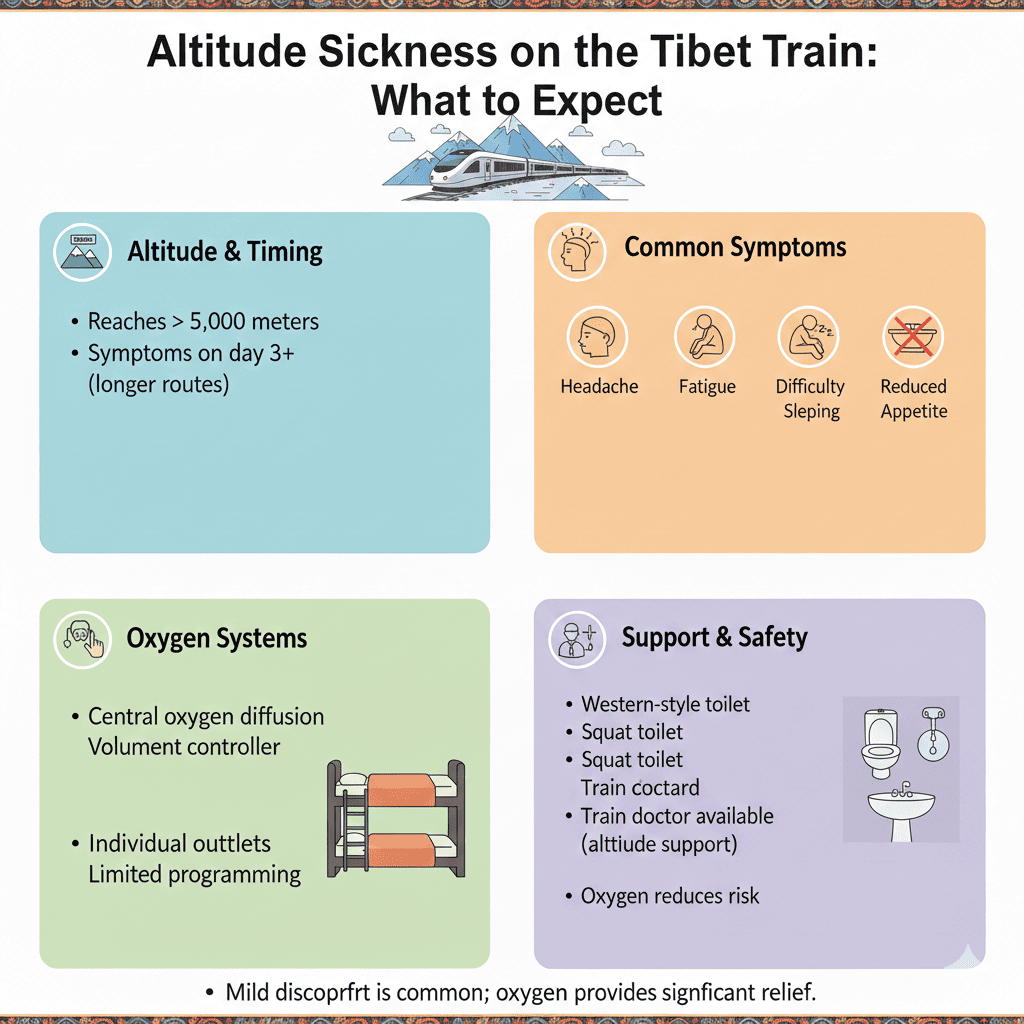
As the train climbs onto the Qinghai–Tibet Plateau, it reaches elevations above 5,000 meters. Around the third day of longer routes (such as Beijing to Lhasa or Shanghai to Lhasa), some passengers may notice mild symptoms of altitude sickness.
Common symptoms include:
- Headache
- Fatigue
- Difficulty sleeping
- Reduced appetite
To reduce discomfort, each carriage is equipped with an oxygen supply system. Passengers can:
- Use central oxygen diffusion in the carriage
- Manually activate individual oxygen outlets near their berth
If symptoms become stronger, notify the conductor immediately. A train doctor is available onboard to provide timely assistance if needed.
Most travelers experience only mild discomfort, and the oxygen system significantly reduces the risk of serious altitude-related issues.
Sleeping and Eating on the Tibet Train
Because the journey to Lhasa can last 20–50 hours depending on departure city, comfort and preparation are key.
Choosing the Right Sleeping Class
There are three main classes on trains to Lhasa:
- Soft sleeper
- Hard sleeper
- Hard seat
For long-distance travel at high altitude, soft sleeper is generally the most comfortable option. It provides more privacy and better rest, which is helpful when adjusting to elevation changes.
Hard sleeper is more budget-friendly and still suitable for most travelers. Hard seat is not recommended for long routes due to limited comfort.
Food and Drinks Onboard
Passengers should bring:
- Snacks
- Instant noodles
- Light meals
Free boiled water is available in every carriage, making it easy to prepare instant food or tea.
Food trolleys move through the train periodically, and a dining car serves hot meals. However, prices can be higher than average, so many travelers supplement with their own food.
Sharing snacks with cabin mates is common and often leads to friendly conversations.
Charging Mobile Phones and Electronic Devices
Staying connected is important during long train journeys. Soft sleeper cabins provide convenient power outlets in two main locations:
- In the corridor
- Under the table between the lower berths
These sockets allow passengers to charge phones, cameras, and laptops while keeping devices within reach. Corridor outlets are recessed for safety and easy access.
There is no onboard WiFi, and mobile signals may be weak in remote areas of the plateau. Bringing a power bank is highly recommended to ensure continuous access to your devices.
Access to charging points makes the Tibet train more convenient, allowing travelers to relax, read, watch movies, or capture scenic views without worrying about battery life.
Are Showers Available on the Tibet Train?
There are no shower facilities onboard.
To stay fresh during the journey, pack:
- Wet wipes
- A small towel
- Toilet paper or tissues
Wet wipes help you stay clean, especially before sleeping. A small towel can be used to wash your face and neck. Although restrooms are cleaned regularly, bringing your own toilet paper is advisable.
Preparing these essentials ensures a more comfortable long-distance train experience.
Can You Change Seats or Cabins to Sit with Family?
If you are not seated in the same cabin as your family or friends, you can politely ask the conductor for assistance.
In many cases, staff will try to help rearrange seating, depending on:
- Seat availability
- Passenger preferences
- Ticket class
Sometimes the conductor may suggest switching seats within your group or moving to vacant berths later in the journey. While changes are not always guaranteed, being polite and flexible increases the chances of sitting together.
Is Smoking Allowed on the Tibet Train?
Smoking is strictly prohibited on the Tibet train.
Because the train operates in a sealed and pressurized environment with oxygen supplied at high altitude, smoking poses serious safety risks. Violations can result in heavy penalties.
Passengers should follow this rule carefully to ensure a safe and comfortable environment for everyone onboard.
Carrying Your Tibet Travel Permit
Foreign travelers must carry the following documents at all times:
- Passport
- Tibet Travel Permit
- Train ticket
Security checks may occur along the route. Keeping documents easily accessible helps speed up inspections.
The Tibet Travel Permit can only be obtained through a registered travel agency. It’s advisable to carry photocopies as backup and understand the permit’s terms and travel restrictions before departure.
Proper preparation ensures smooth travel across the region.
How to Minimize the Effects of Altitude Sickness
Altitude affects people differently. To reduce potential symptoms:
- Rest well before arrival in Lhasa
- Avoid alcohol during the journey
- Drink plenty of water
- Eat light meals
- Consider altitude medication after consulting a doctor
When feeling discomfort, use the oxygen outlet near your berth. The onboard oxygen system is easy to operate and designed specifically for high-altitude travel.
There is no need for excessive concern—most passengers adjust gradually during the train journey.
Taking the Shanghai–Tibet Train
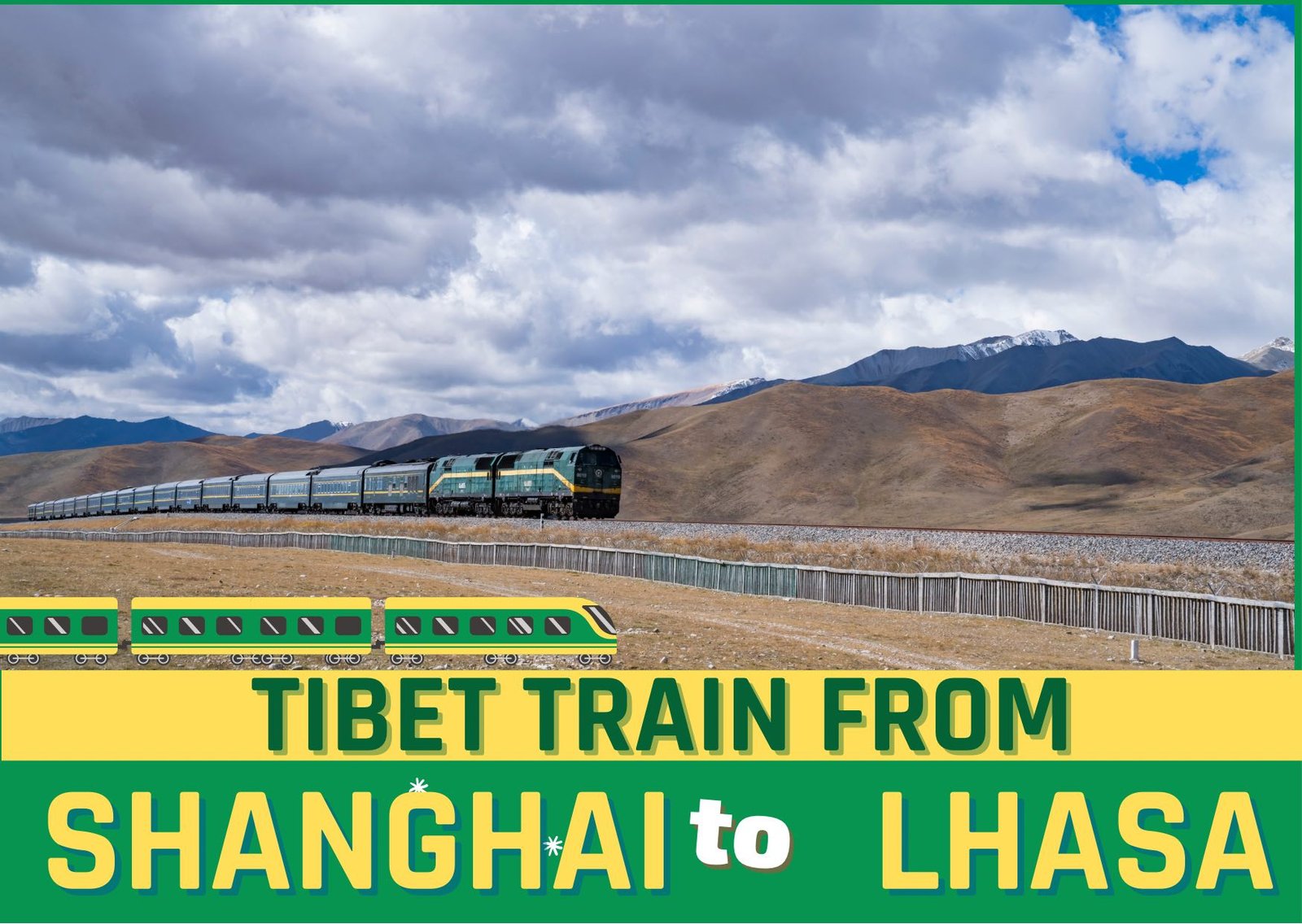
The Shanghai–Lhasa train is one of the longest railway journeys in China, offering dramatic changes in scenery—from modern cities to vast grasslands and snow-covered mountains.
Traveling this route allows you to:
- Witness diverse landscapes
- Experience gradual altitude acclimatization
- Enjoy comfortable sleeper cabins
- Observe local culture along the way
Whether departing from Shanghai, Beijing, Xining, or another major city, the Tibet train journey offers a unique way to reach Lhasa while enjoying one of the world’s most scenic high-altitude railways.