Soft Sleeper on the Tibet Train: Comfort, Privacy, and Facilities Explained
The soft sleeper class on the Qinghai–Tibet Railway is widely considered the best accommodation option for travelers heading to Lhasa from cities such as Beijing, Shanghai, Guangzhou, or Xining. For a journey that can last anywhere from 20 to 50 hours, comfort becomes essential.
Soft sleepers offer an ideal balance of privacy, space, and onboard amenities. They are especially recommended for families, elderly passengers, couples, and anyone who wants a quieter and more restful experience while crossing the Tibetan Plateau at elevations exceeding 5,000 meters.
Layout and Design of Soft Sleeper Cabins
Each soft sleeper compartment is a private, enclosed cabin with four berths arranged in two tiers:
- Two lower berths
- Two upper berths
Cabin Specifications
| Feature | Soft Sleeper Details |
|---|---|
| Berths per cabin | 4 (enclosed with sliding door) |
| Berth size | 75 cm wide × 190 cm long |
| Weight capacity | Up to 300 kg |
| Headroom (lower berth) | Approx. 90 cm |
| Headroom (upper berth) | Approx. 80 cm |
| Total soft sleeper cars per train | Usually 2 |
| Total capacity | About 64 passengers |
The cabin includes:
- A large window for scenic plateau views
- A small table between lower berths
- Foldable ladders for upper berth access
- A sliding door facing the corridor
Because there are only two soft sleeper carriages per train, the environment tends to be quieter and less crowded than other sections.
Lower berths can double as seating during the day, making them convenient for socializing or enjoying the view. Upper berths, accessed via ladder, offer greater privacy.
Comfort Features on the Tibet Train
Soft sleeper facilities are designed to make long-distance travel more manageable at high altitude.
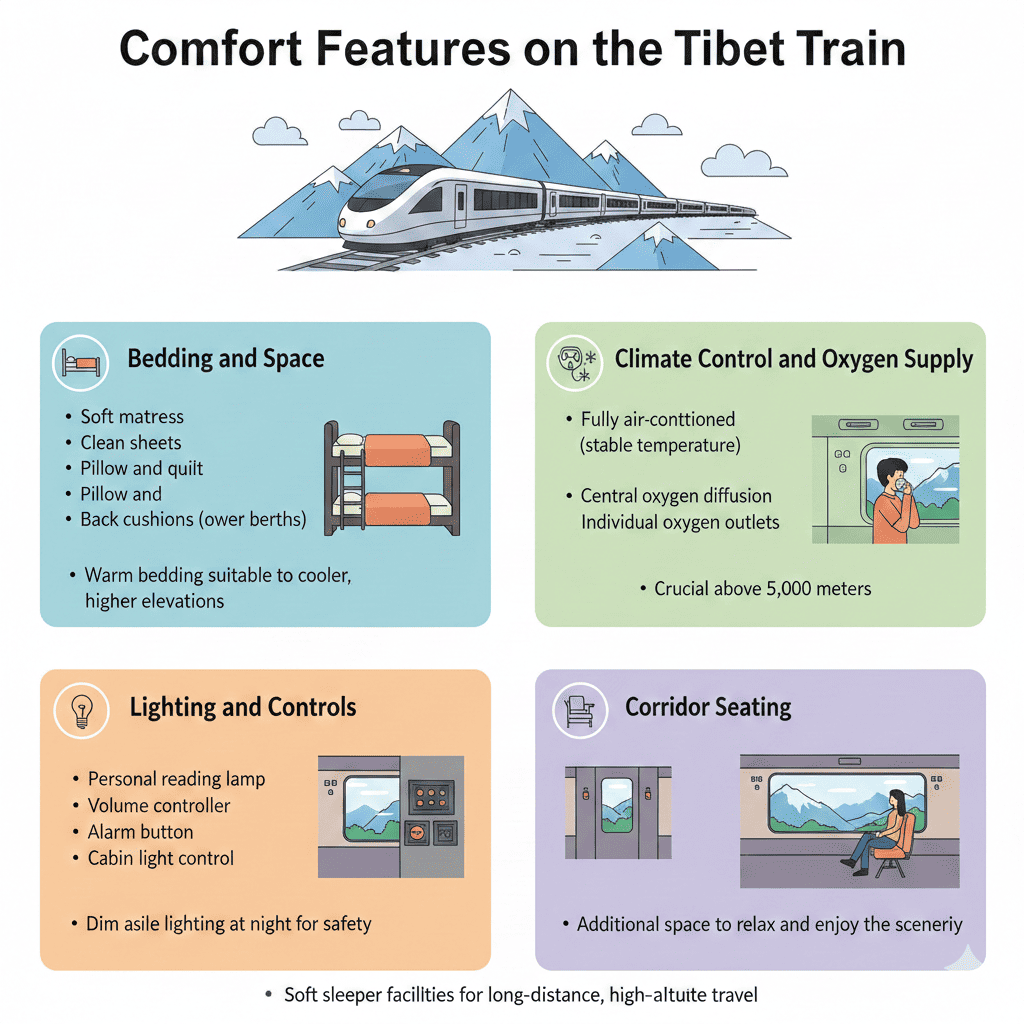
Bedding and Space
Each berth includes:
- Soft mattress
- Clean sheets
- Pillow and quilt
- Back cushions (especially for lower berths)
While the mattresses are relatively firm, they are comfortable enough for overnight travel. The bedding is warm and suitable for cooler temperatures at higher elevations.
Climate Control and Oxygen Supply
Tibet trains are fully air-conditioned, maintaining a stable cabin temperature. More importantly, they are equipped with oxygen systems to help reduce altitude discomfort.
Passengers benefit from:
- Central oxygen diffusion throughout the carriage
- Individual oxygen outlets near each berth
These features are particularly valuable as the train crosses high mountain passes above 5,000 meters.
Lighting and Controls
Each berth is equipped with:
- Personal reading lamp
- Volume controller
- Alarm button
Passengers can control the main cabin light, while dim aisle lighting remains on for safety during the night.
Corridor Seating
Foldable seats along the corridor provide additional space for relaxing or enjoying the landscape without crowding the cabin.
Privacy Advantages of Soft Sleeper
Privacy is one of the main reasons travelers choose this class.
Lockable Cabin Doors
Each cabin features a sliding door that can be locked from the inside. This significantly reduces noise from the corridor and creates a secure, peaceful environment—especially useful during overnight segments.
Berth-Level Privacy
- Upper berths offer more seclusion since they are not used for daytime seating.
- Lower berths provide more headroom but may feel slightly less private if the cabin door is open.
For families or groups of four, booking an entire cabin ensures complete privacy throughout the journey.
Compared to other classes, the soft sleeper section feels noticeably calmer and more relaxed.
Amenities and Facilities in Soft Sleeper Carriages
Soft sleeper cabins include several additional conveniences that improve the overall travel experience.
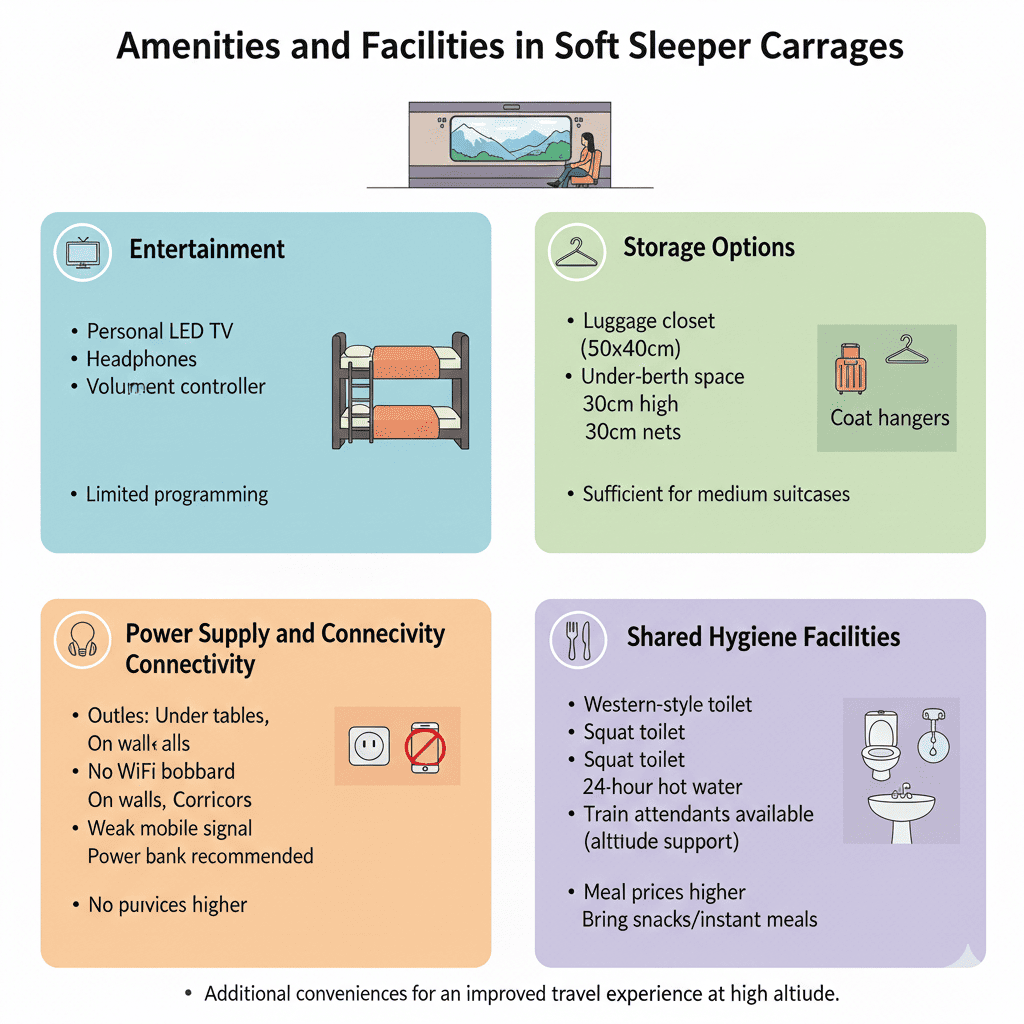
Entertainment
Each berth is equipped with:
- Personal LED TV
- Headphones
- Independent channel and volume controls
Programming is limited, but it offers entertainment during long stretches of travel.
Storage Options
Passengers have access to:
- Luggage closet (approx. 50 cm × 40 cm)
- Under-berth storage space (approx. 30 cm high)
- Overhead storage nets
- Coat hangers
These storage solutions are sufficient for medium-sized suitcases and personal items.
Power Supply and Connectivity
Power outlets are available:
- Under tables
- On cabin walls
- In corridor areas
However, WiFi is not available onboard, and mobile signals may be weak in remote plateau areas. Bringing a power bank is highly recommended.
Shared Hygiene Facilities
Each soft sleeper carriage includes:
- One Western-style toilet
- One squat toilet
- Washbasins with mirrors
- 24-hour hot water dispenser
Facilities are shared and cleaned regularly. There are no private bathrooms inside cabins.
Dining Services
Passengers can:
- Visit the dining car
- Purchase food from onboard trolleys
Meal prices are typically higher than average, so many travelers bring snacks or instant meals to supplement onboard options.
Onboard Support
Train attendants are available to assist passengers, including providing basic support for altitude-related discomfort.
Soft Sleeper vs Hard Sleeper: Key Differences
When deciding between classes on the Tibet train, the comparison below highlights the main distinctions:
| Feature | Soft Sleeper | Hard Sleeper |
|---|---|---|
| Berths per cabin | 4 (enclosed) | 6 (open to corridor) |
| Berth size | 75 cm × 190 cm | 60 cm × 180 cm |
| Privacy | Lockable door; high privacy | Open cabin; minimal privacy |
| Bedding | Softer, more spacious | Basic bedding |
| Oxygen outlet | Individual outlets | Shared/central supply |
| Entertainment | Personal TV | No TV |
| Atmosphere | Quiet and spacious | Noisier and crowded |
| Approx. Beijing–Lhasa price | ~¥1,144 CNY | ~¥720 CNY |
Soft sleepers cost more, but the additional privacy, space, and amenities make them a strong value for long-distance travel across the plateau.
Booking Tips for Soft Sleeper Tickets
Because there are only two soft sleeper carriages per train, tickets sell out quickly—especially during peak travel season from June to September.
Helpful Booking Advice
- Book as early as possible.
- Choose lower berths for easier access and more headroom (usually slightly more expensive).
- Choose upper berths for greater privacy and lower cost.
- If traveling as a group of four, reserve an entire cabin for maximum comfort.
- Prepare for shared bathrooms and bring personal toiletries.
Is Soft Sleeper Worth It on the Tibet Train?
For journeys lasting 20–50 hours at high altitude, comfort and privacy can significantly impact your overall travel experience. Soft sleeper cabins provide a quiet environment, better sleeping space, oxygen support, and added amenities that make the long ride to Lhasa more enjoyable.
For travelers seeking a smooth, comfortable, and private experience on one of the world’s highest railways, the soft sleeper remains the top choice on the Tibet train.